There is a version of this post that opens with market statistics. This is not it, because nobody moves to East Dallas for a statistic. They move here for a body of water the city built to drink out of and then stopped drinking out of, and for streets laid down before anyone thought a garage needed three bays.
White Rock Lake is the argument for this part of town, and everything else arranges itself around that one piece of geography, so the lake goes first and the numbers go near the end. The numbers are our own: we counted redevelopment out of our MLS warehouse, ownership and lot sizes out of the Dallas County appraisal roll. Facts about the lake and the city come from the City of Dallas, the Texas Water Development Board, the Dallas Arboretum or a named news outlet.
Key Takeaways
- White Rock Lake was built as Dallas's drinking water reservoir, with the dam finished in 1911, and it stopped serving as the city's water supply on July 2, 1930. It has been a park ever since.
- The loop is the amenity: about nine and a third miles of continuous public trail, per Dallas Park and Recreation.
- The rebuilding is measurable, and the lot is what is being bought. In our matched teardown study 75214 is the second most rebuilt ZIP code in the metro at 70 matched pairs and 75218 is fifth at 35, and a 75214 house built in the 2020s is about two and a half times the size of a 1950s house on a lot that is essentially the same size.
- Nobody institutional owns this place. Owners holding ten or more houses in Dallas County hold 0.38 percent of the parcels in 75214 and 1.31 percent in 75218, against 2.5 percent countywide.
- Both ZIP codes sit under the six months of supply that marks a balanced market, and both are still negotiating.
The Lake Came First, and It Was Never Meant To Be Scenery
Dallas built White Rock Lake to drink. Voters approved the bonds in 1909, the dam was finished in 1911, and the city drew its primary drinking water from the reservoir until July 2, 1930, according to the City of Dallas Office of Historic Preservation. After that it became a park with a long shoreline.
That origin explains the shape of everything around it. A water supply reservoir gets a buffer of public land, which is why there is a continuous public loop instead of a ring of private waterfront lots, and why the houses near the water are modest by the standards of what they sit next to. The lake did not attract mansions in 1925, because in 1925 it was infrastructure.
The origin also explains the silt. A reservoir fed by a creek fills in, and this one has been filling in for a century. Texas Water Development Board survey work put capacity at roughly 10,230 acre feet against an original near 18,000, with sediment up to eight feet deep in places. Dallas has dredged it in 1937, 1955, 1974 and 1998, and Park and Recreation has warned that without another dredging the lake could silt in within the decade. That is the largest public works question hanging over the neighborhood.
What It Is Actually Like To Live Here
The loop is what residents use most. Dallas Park and Recreation lists it at 9.33 miles on the lake's page and 9.4 miles on its trails index; the city's own two pages disagree, which we would rather flag than launder into one confident number, so call it about nine and a third miles of continuous public path.
On the east shore sits the Dallas Arboretum and Botanical Garden, 66 acres assembled from the DeGolyer estate and the 22 acre Alex Camp property, incorporated in 1974 and opened in 1984. It is the one destination people drive in from other counties to see, which is an amenity and, on a spring Saturday, a traffic condition. On the west shore, the Bath House Cultural Center, built in 1930, stopped being a bath house when lake swimming ended in 1953 and reopened in 1981 as the city's first neighborhood cultural center.
Off the water, the anchors are old. The Lakewood Theater opened on October 27, 1938 and the City Council designated it a landmark on September 14, 2016, which is why the marquee is still there. Casa Linda Plaza dates to 1945 and is regularly described as the oldest shopping center in Dallas. Woodrow Wilson High School opened on September 14, 1928, carries a Recorded Texas Historic Landmark designation from 1989 and a city landmark designation from January 22, 1992, and became an International Baccalaureate World School on March 18, 2011. The grocery run, the school and the theater all predate the interstate.
The Neighborhoods, and Which Ones Come With Rules
East Dallas is not one neighborhood, and the ZIP codes do not map cleanly onto the names people use. Broadly: 75214 is Lakewood and the west shore, 75218 is Casa Linda, Forest Hills and the east shore, 75206 is Lower Greenville and Vickery Place, 75223 is Junius Heights and Hollywood Heights, and 75228 runs east through Casa View.
What matters when you buy is which carry design rules, because a historic or conservation district changes what you can do to the outside of the house. Munger Place was designated a City of Dallas historic district in 1980. Junius Heights followed in May 2005, the largest in the city by area at the time. Peak's Suburban Addition became a landmark district in 1995 and was listed on the National Register of Historic Places the same year. Hollywood Heights and Santa Monica is a conservation district, a lighter overlay about massing and setbacks rather than window muntins.
Lakewood, Forest Hills, Little Forest Hills, Casa Linda and Old Lake Highlands carry no such designation we can confirm from city records. That cuts both ways: no overlay means no design review when you add a second floor, and none when the house next door comes down.
What Is Being Torn Down, and What Goes Back Up
We built a teardown study out of our own MLS warehouse. The method is deliberately narrow: a house built in 1980 or earlier that closed, then the same street address reappearing with a house built in 2022 or later. First qualifying rebuild wins, each address counted once.
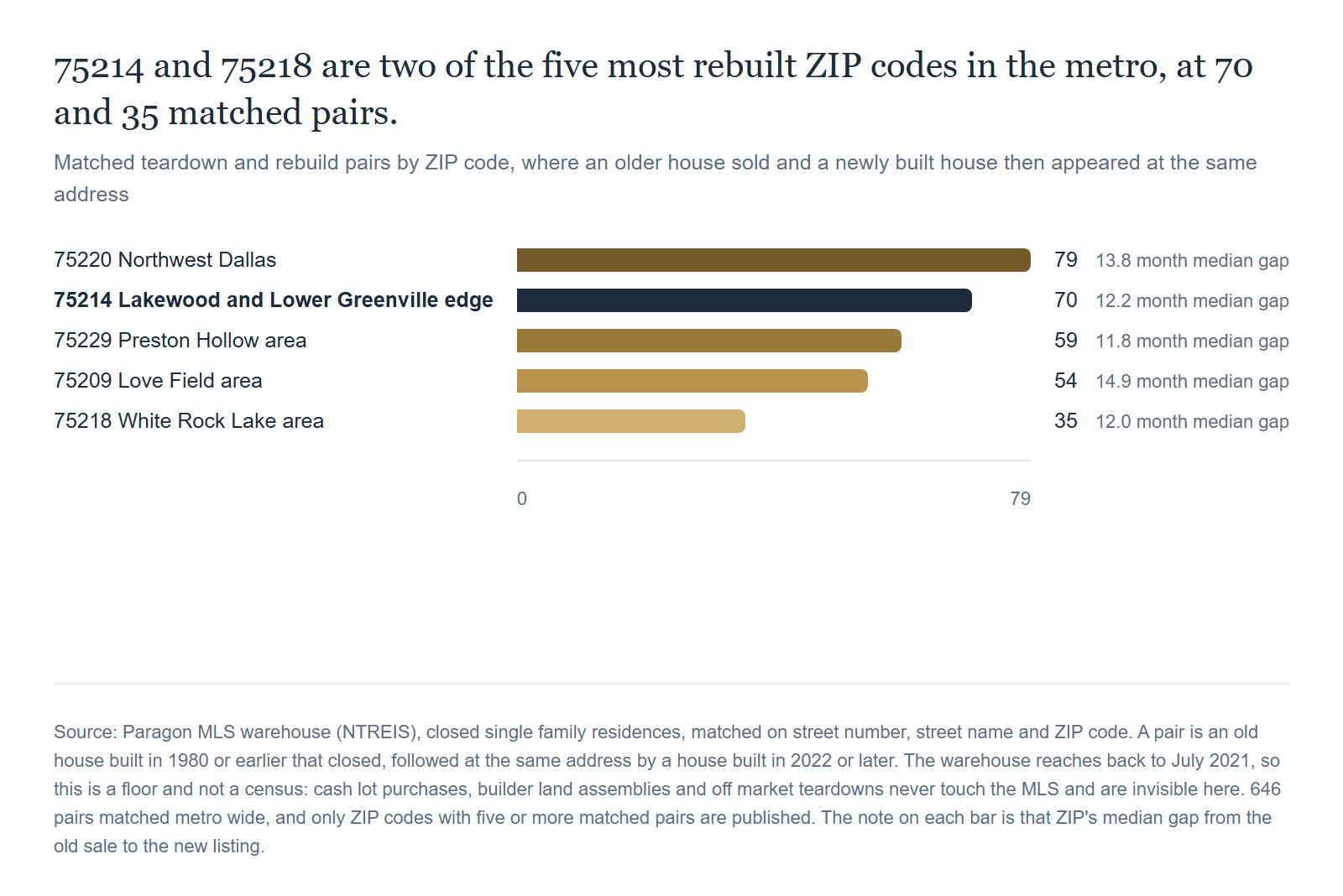
Metro wide that matched 646 pairs, and the five carrying the most are 75220 with 79, 75214 with 70, 75229 with 59, 75209 with 54, and 75218 with 35. Two of the five most rebuilt ZIP codes in Dallas Fort Worth ring this lake.
The caveat matters more than the ranking. This is a floor, not a census: it counts only rebuilds where both the old sale and the new house touched the MLS, and our warehouse reaches back to July 2021. Cash lot purchases, builder land assemblies and off market teardowns are invisible to it, so the real number here is higher than 70 and higher than 35, and we cannot say by how much.
Scale it against the stock. The appraisal roll carries 8,967 detached single family parcels in 75214 and 7,241 in 75218, so the matched rebuilds are 0.78 percent of the houses in 75214 and 0.48 percent in 75218. This is not a neighborhood being demolished. It is one where fewer than one house in a hundred has been through the cycle in the window we can see.
The Lot Is What Somebody Is Buying
Here is the part a homeowner in Lakewood should read twice, because it explains the letters that keep arriving in the mail.
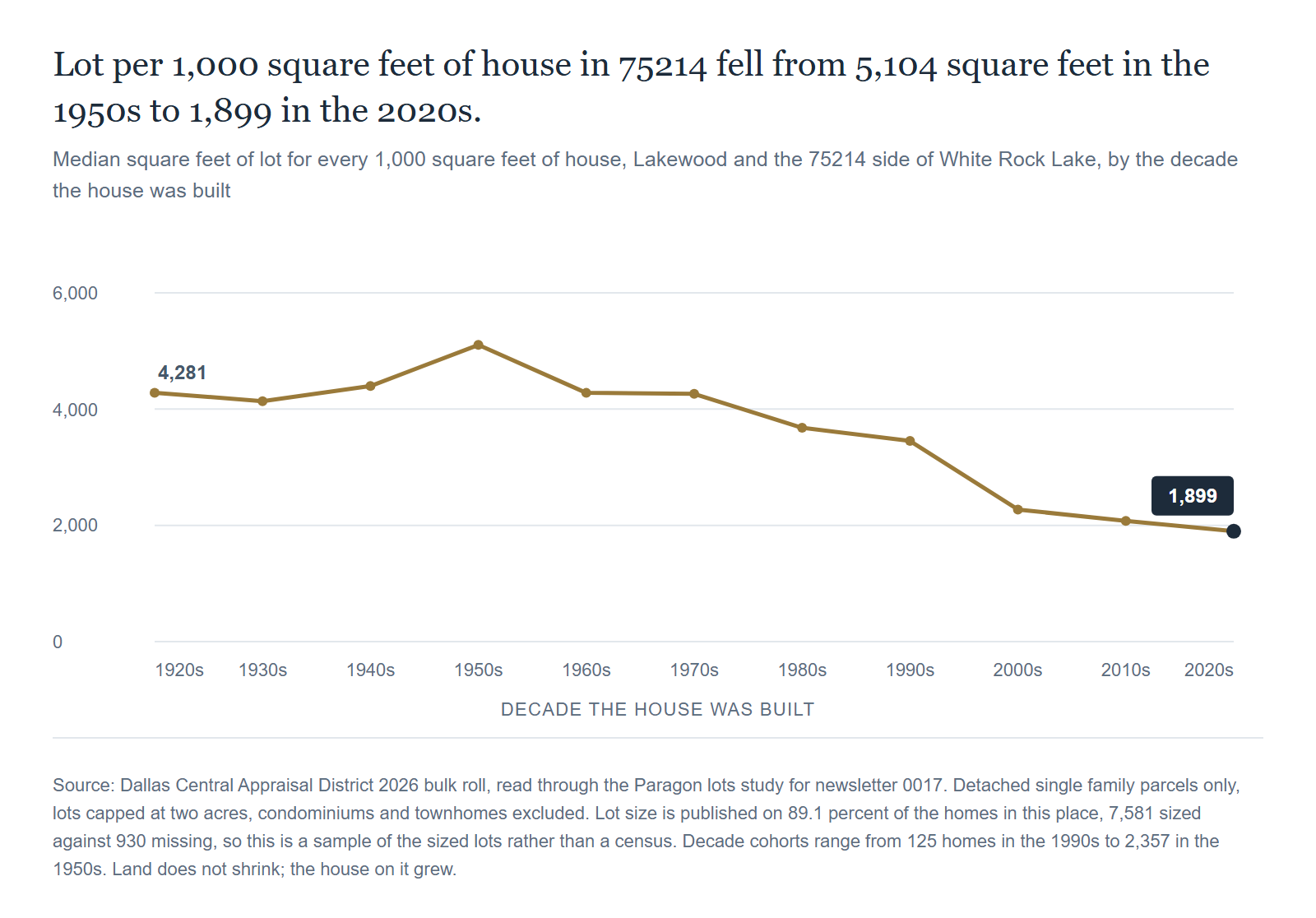
Sort every house in Lakewood and the 75214 side of the lake by the decade it was built, using the Dallas Central Appraisal District's record of building and land size. A 1950s house sits on 5,104 square feet of lot for every 1,000 square feet of house. A 2020s house sits on 1,899.
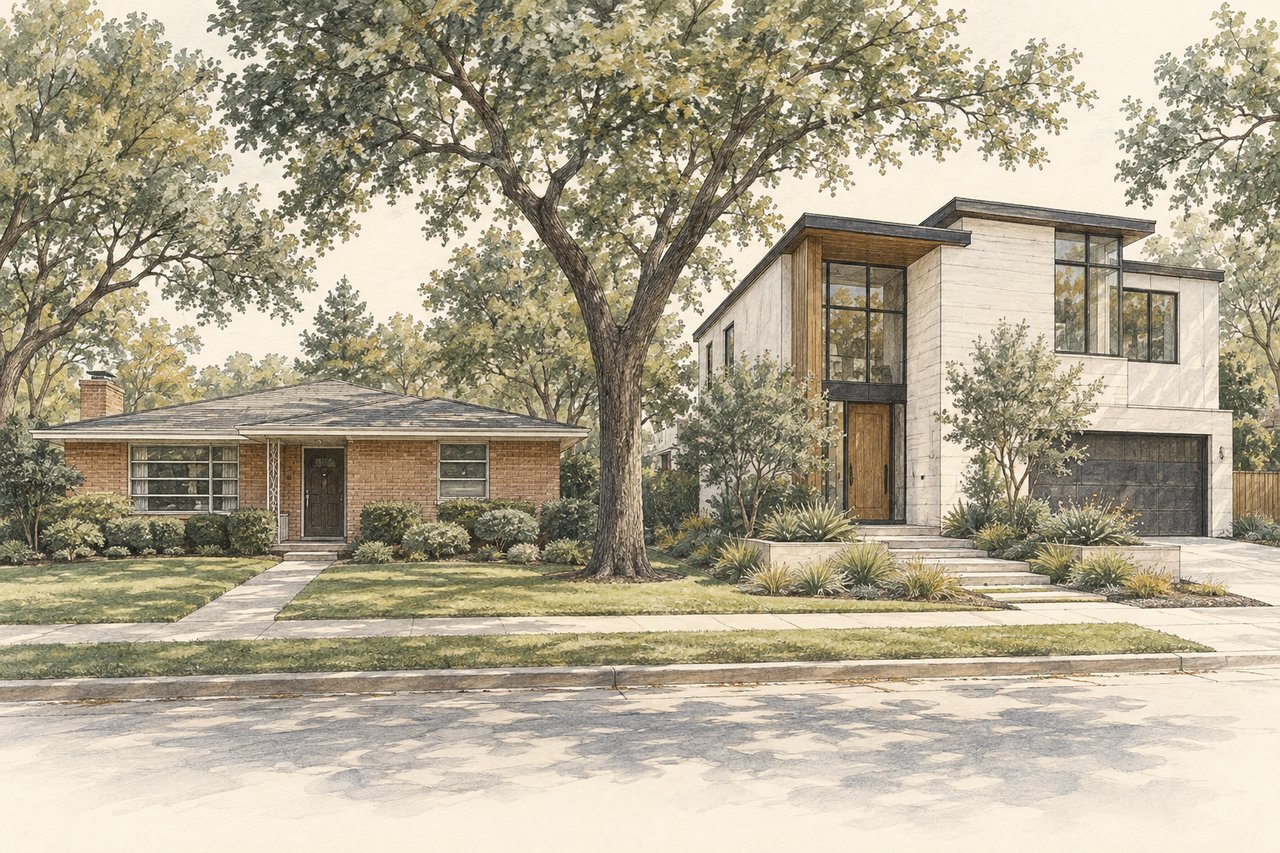
The land did not shrink. The median lot under a 1950s house in 75214 measures 8,918 square feet and under a 2020s house 8,642, within a rounding error of the same ground. What changed is the building: 1,813 square feet at the 1950s median against 4,675 at the 2020s median, about two and a half times as much house on the same dirt.
That is the redevelopment thesis in one comparison. The 1950s cohort is also the biggest here, 2,357 of the 7,581 homes with a published lot size, or 31.1 percent, so the most common house in Lakewood is the exact house this math targets.
Read the shape of that line rather than any one decade: the roll publishes no lot size for some homes here, and the thinnest cohort holds 125.
Who Actually Owns the Houses
The other question we get constantly is whether an investor is buying the block. We counted it out of the Dallas County appraisal roll rather than out of a theory.
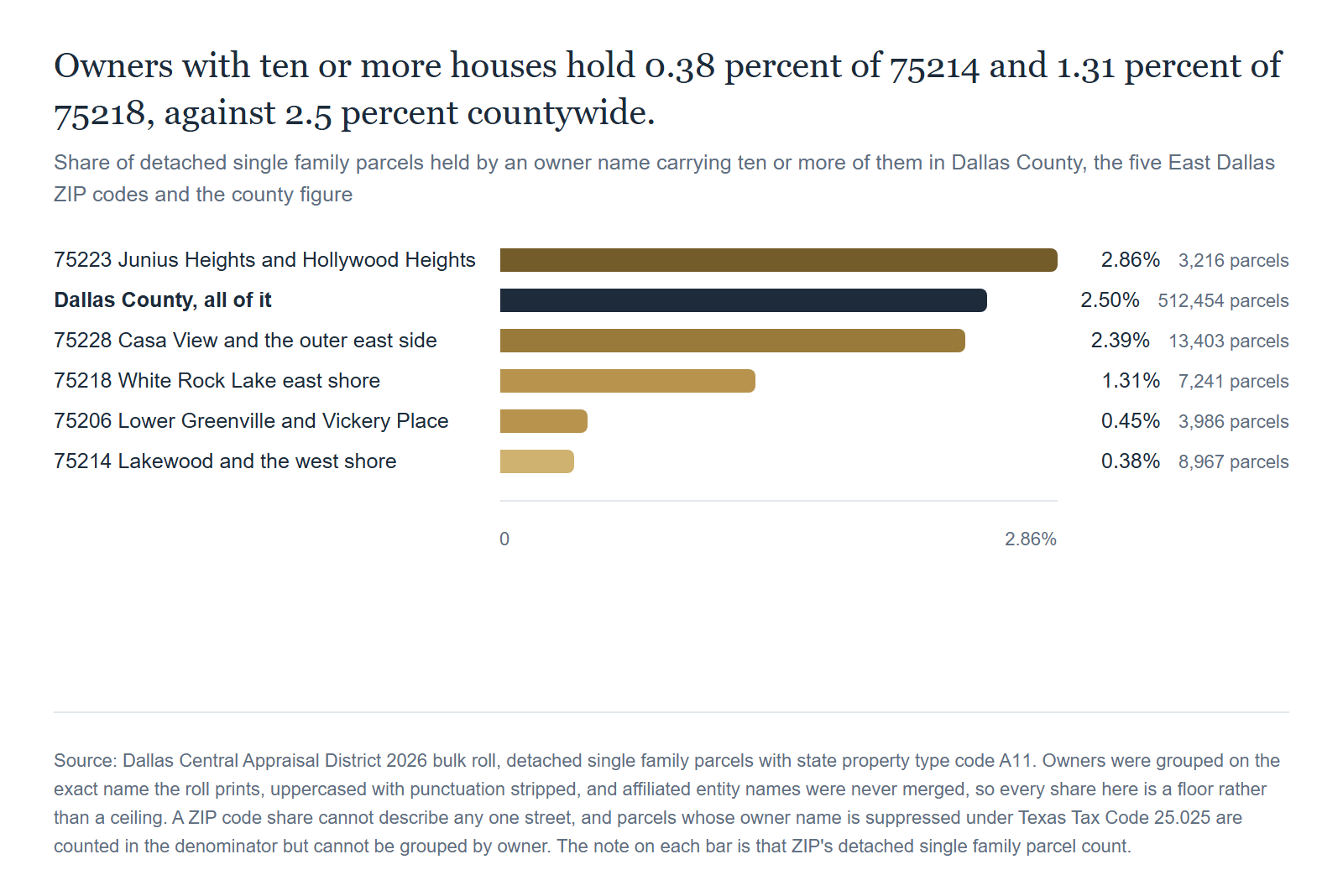
Group every detached single family parcel by the exact owner name the roll prints, count how many each name holds in the county, and call any name with ten or more a large owner. Countywide that group holds 2.5 percent of the houses. In 75214 it holds 0.38 percent of 8,967 parcels and in 75218 1.31 percent of 7,241. Of the five East Dallas ZIP codes on the chart, only 75223 sits above the county figure.
Institutional scale ownership here is close to absent. Two caveats: we merged nothing, so affiliated entity names counted separately and every share is a floor, and a ZIP code average cannot describe one street. The pressure on East Dallas is not a fund. It is a builder with a lot study.
Getting Around, and the Honest Downsides
Transit is adequate rather than excellent. The DART Blue Line serves White Rock Station at Northwest Highway and Loop 12 and Lake Highlands Station, opened December 6, 2010, but neither puts you on the west shore, so for most people here the commute is a car. The trail network is better: Dallas Park and Recreation lists the Santa Fe Trail at 4 miles, connecting to the west side of the lake, and the White Rock Creek Trail at 7.6 miles running north.
Now the downsides, because a spotlight that only lists amenities is an advertisement.
Traffic and parking. Garland Road is the main artery and carries Arboretum visitors on top of residents. Winfrey Point parking has been contested for more than a decade; a proposed parking structure serving the Arboretum was floated and dropped after Park Department pushback, as the Dallas Morning News reported in 2012.
Water quality. This is not a swimming lake and has not been since 1953. In March 2024 a lift station valve failure in Plano released roughly 1.5 million gallons of sewage into White Rock Creek and the lake beginning March 14, 2024. Dallas Water Utilities found elevated E. coli, and Park and Recreation suspended water recreation from March 19, 2024 to March 24, 2024, per Dallas Morning News reporting.
The silt. The 2024 Dallas bond program included $20 million for dredging within Proposition B, intended to pair with roughly $60 million from the US Army Corps of Engineers. A master plan update went before a city task force on August 13, 2024 and a public feasibility meeting was held in December 2025, and published timelines put the earliest realistic start around late 2028. The lake you are buying next to is on a public works clock with a partly federal dependency. The tree canopy is exposed too: the straight line wind event of June 9, 2019 brought gusts to 71 miles per hour at Love Field and took hundreds of park trees citywide, with heavy damage around the lake.
The Paragon Angle
Our read: White Rock Lake and East Dallas are not a price story right now. They are a land story wearing a house.
The evidence is consistent across three datasets that share no method. The MLS warehouse says two of the five most rebuilt ZIP codes in the metro are here. The appraisal roll says the most common house in Lakewood is a 1950s building of about 1,813 square feet on ground that now supports 4,675, and that almost nobody institutional owns anything here, so the buyer for that ground is a builder or a family.
Practically: if you own a mid century house on a full lot in 75214 or 75218, you own two assets priced differently, and only one of them has your kitchen in it. The letters in your mailbox are not addressed to your house. Two owners on the same street can be in different negotiations depending on which asset the buyer wants, and the tell is how little they ask about the interior.
The counterargument is fair. Only 0.78 percent of 75214 has been through the rebuild cycle in the window we can measure, and anybody claiming Lakewood is becoming a subdivision of new builds is arguing against the new construction share reported in the market section below. The character risk here is slow and cumulative, not sudden. What we will not do is tell you what a new house next door does to your value, because we did not measure it.
How Is the Market in White Rock Lake and East Dallas?
Every market figure in this post lives in this section, all of it from our own NTREIS warehouse, medians only, windows stated. Nothing here is a sale price.
The two ZIP codes move at different speeds. In 75214 the median listing went under contract in 17 days; in 75218 it took 26.5, a gap of 9.5 days on the same lake. Supply is tight in both and tighter in 75218, 3.07 months against 3.83 in 75214.
New construction as a share of what sells stays low here too. In the twelve months ending September 16, 2026 it was 9.6 percent of single family closings in 75214 and 8.2 percent in 75218, against 25.4 percent across the region we measure. East Dallas is not a new construction market. It is an old market with a rebuild rate.
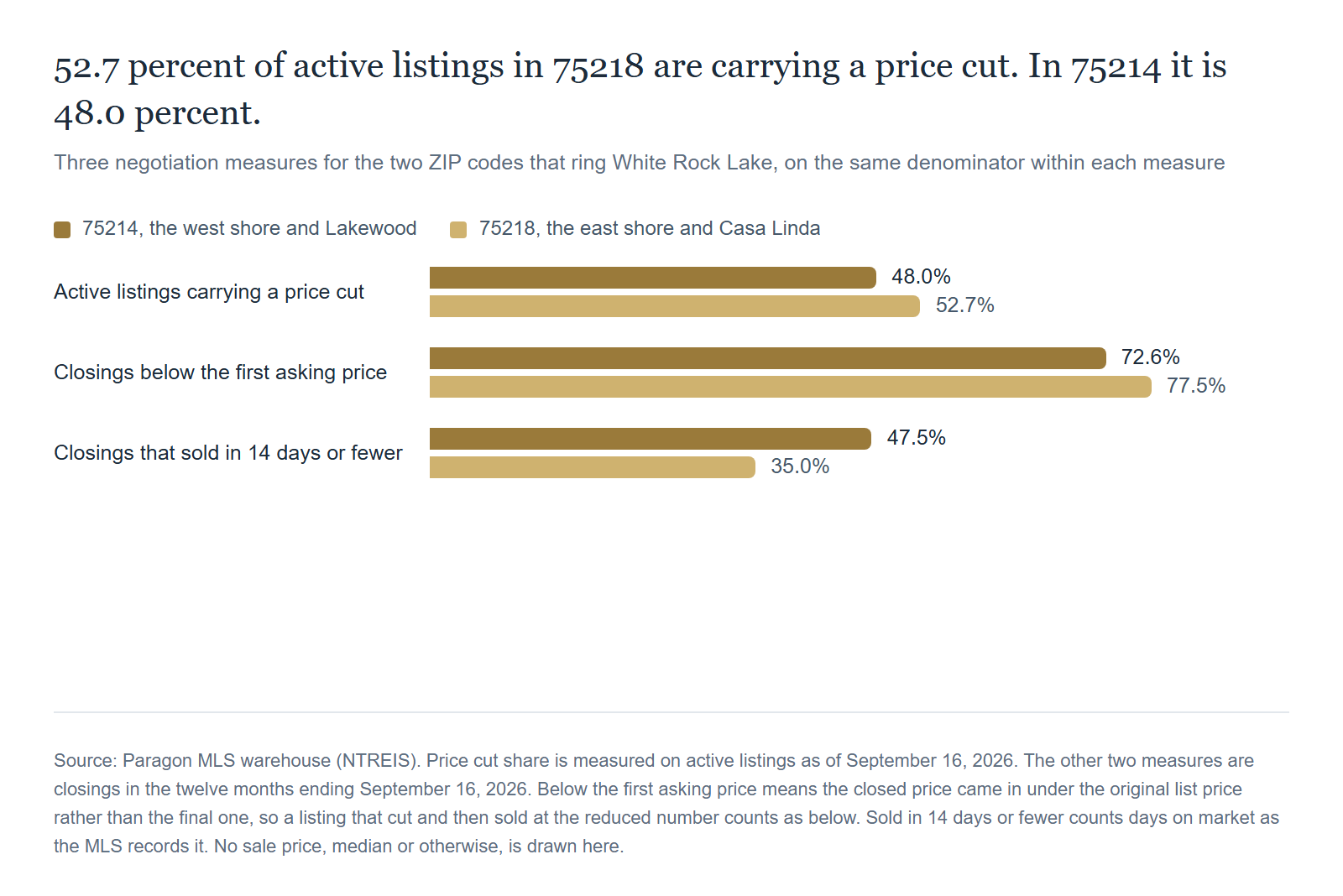
Tight supply is not the same as no negotiation, and this is where sellers get surprised. More than half of everything active in 75218 is already carrying a price cut, and better than seven in ten closings on both shores landed below the first asking price rather than the final one. The market is fast for correctly priced houses and slow for everything else; the chart and table carry the figures.
Full list, for reference.
Measure | 75214 | 75218 |
|---|---|---|
Median days on market | 17 | 26.5 |
Months of supply | 3.83 | 3.07 |
Active listings carrying a price cut | 48.0% | 52.7% |
Closings below the first asking price | 72.6% | 77.5% |
Closings sold in 14 days or fewer | 47.5% | 35.0% |
New construction share of closings | 9.6% | 8.2% |
Matched teardown and rebuild pairs | 70 | 35 |
Held by an owner with ten or more houses | 0.38% | 1.31% |
For a seller, the first two weeks are the whole negotiation, and a listing that cuts will most likely close below where it started. For a buyer, roughly three quarters of closings on both shores settled under the original ask, so the first number is a starting position far more often than a clearing price.
Frequently Asked Questions
Is White Rock Lake a swimming lake?
No. Lake swimming ended in 1953. It is used for rowing, paddling, sailing, fishing, running and cycling, and water contact recreation is occasionally suspended after upstream sewage events, as from March 19, 2024 to March 24, 2024.
Which East Dallas neighborhoods have historic district rules?
Munger Place was designated in 1980, Junius Heights in May 2005, and Peak's Suburban Addition became a landmark district in 1995 with a National Register listing the same year. Hollywood Heights and Santa Monica is a conservation district, a lighter overlay. Lakewood, Forest Hills, Little Forest Hills, Casa Linda and Old Lake Highlands carry no such designation we can confirm.
Are investors buying up East Dallas?
Not at institutional scale, on the evidence. On the Dallas County 2026 appraisal roll, owner names holding ten or more detached houses in the county hold 0.38 percent of the parcels in 75214 and 1.31 percent in 75218, against 2.5 percent countywide. We merged no affiliated entity names, so those are floors, and a ZIP code share cannot describe one street.
Is my 1950s house in Lakewood a teardown candidate?
We cannot answer that about a specific house and would not try. What the data says is that the 1950s cohort is the largest in 75214, its median building is 1,813 square feet, and the median house built here in the 2020s is 4,675 square feet on a lot of essentially the same size. That gap is what the letters in your mailbox are about.
Conclusion: Buy the Lake, Understand the Lot
White Rock Lake has been a park far longer than it was ever a water supply, and it will still be a park in ten years. That is why an East Dallas address has held its appeal through several very different markets.
What is changing is underneath the houses, not around the lake. Two of the five most rebuilt ZIP codes in Dallas Fort Worth are on this shoreline, and the houses built here in the 2020s carry two and a half times the structure of that 1950s median on a lot of the same size. Essentially none of that is institutional, which means builders and families are doing it one lot at a time. The market underneath is genuinely two markets, 17 days at the median in 75214 against 26.5 in 75218, both on tight supply and both still negotiating.
If you own here, the question to answer before you list is which asset you are selling, the house or the lot. If you are buying, the question is which of the two the seller thinks they are selling.
Talk to Paragon
We run this analysis out of our own data because the questions around this lake are specific and the generic answer is usually wrong. If you want the numbers for your own block, we are glad to pull them.
Email: [email protected]
Phone: (469) 290-7593
Online: paragondfw.com/contact
Related Articles
- The 380 Scorecard: Twenty Projects Were Promised on This Corridor. Six Are Open.
- One in Four DFW Closings Is a Brand New House: In the Older Inner ZIPs, the Next House Sold for 3.48 Times as Much
- Does One Landlord Own Half Our Street? In Dallas County, Owners With Ten or More Houses Hold 2.5 Percent of Parcels
Sources
- Paragon MLS warehouse (NTREIS), spotlight source card for issue 0017, pulled September 16, 2026, public aggregate mode, medians only. Days on market, sale to list and price cut figures cover the twelve months ending September 16, 2026; months of supply uses June 18, 2026 through September 16, 2026; price cut share is measured on actives as of September 16, 2026. Based on information from the North Texas Real Estate Information Systems, Inc. Data deemed reliable but is not guaranteed accurate by the MLS or NTREIS.
- Paragon teardown and rebuild study for issue 0017, built against the same warehouse on September 16, 2026. 646 pairs matched metro wide; only ZIP codes with five or more matched pairs are published. The warehouse reaches back to July 13, 2021, so the count is a floor.
- Dallas Central Appraisal District, 2026 bulk roll, detached single family parcels with state property type code A11, for parcel counts, ownership grouping and lot and building sizes by decade. Owner names were grouped exactly as printed with no merging of affiliated entities, so every ownership share is a floor. Lot size is published on 89.1 percent of the Lakewood parcels sampled.
- City of Dallas Park and Recreation, White Rock Lake park page and the Loop Trails and Linear Trails indexes, for the 9.33 mile and 9.4 mile trail figures, the Santa Fe Trail at 4 miles, the White Rock Creek Trail at 7.6 miles and the Katy Trail at 3.5 miles.
- City of Dallas Office of Historic Preservation, history of White Rock Lake, for the 1909 bonds, the 1911 dam and the end of drinking water service on July 2, 1930; and Texas Water Development Board reservoir survey material for the capacity and sedimentation figures and the 1937, 1955, 1974 and 1998 dredging history, and Advocate Magazine (October 25, 2021) for the silt-in warning.
- Dallas Arboretum and Bath House Cultural Center About pages, for the 66 acre garden, the 22 acre Alex Camp property, the 1974 incorporation, the 1984 opening, the 1930 bath house, the 1953 end of lake swimming and the 1981 reopening.
- The Dallas Morning News, for the March 2024 Plano sewage release and the recreation suspension from March 19, 2024 to March 24, 2024, the June 9, 2019 wind event and the 71 mile per hour gust at Love Field, and Winfrey Point parking coverage. The September 14, 2016 Lakewood Theater landmark designation is from contemporaneous Texas television coverage (KBTX) of the council vote.
- City of Dallas historic preservation designation records and the Texas Historical Commission Atlas, for Munger Place in 1980, Junius Heights in May 2005, Peak's Suburban Addition as a 1995 landmark district and National Register listing, and Woodrow Wilson High School's 1989 state landmark and January 22, 1992 city landmark designations.
- City of Dallas 2024 bond program, Proposition B, for the $20 million dredging allocation, the intended pairing with roughly $60 million in US Army Corps of Engineers funding, the August 13, 2024 master plan update and the December 2025 feasibility meeting; Dallas Express bond coverage for the late 2028 timeline; and DART station pages for White Rock and Lake Highlands stations.
- Method note: the redevelopment and ownership counts here are counts of construction and of ownership, not pricing. Every market figure sits in one section, and no sale price appears anywhere in this post.