A Dallas design magazine's fall 2026 issue ran a list of 15 houses it wants saved, and its opening says Dallas keeps losing significant older homes to demolition. That raises a plainer question about the houses nobody is putting on a list. How many Dallas houses are still standing that are about 100 years old or older, and where do they sit?
We answered it for every single family house in Dallas County. This is a lookup piece. Find your ZIP, then your street, and see whether you live on the list.
Two cautions up front. First, the "year built" in these records is the year the county has on file, which is not always the year the house went up, and for very old homes it can be a best guess. Second, a house being old is not the same as a house being protected. We explain both below, plainly.
Key Takeaways
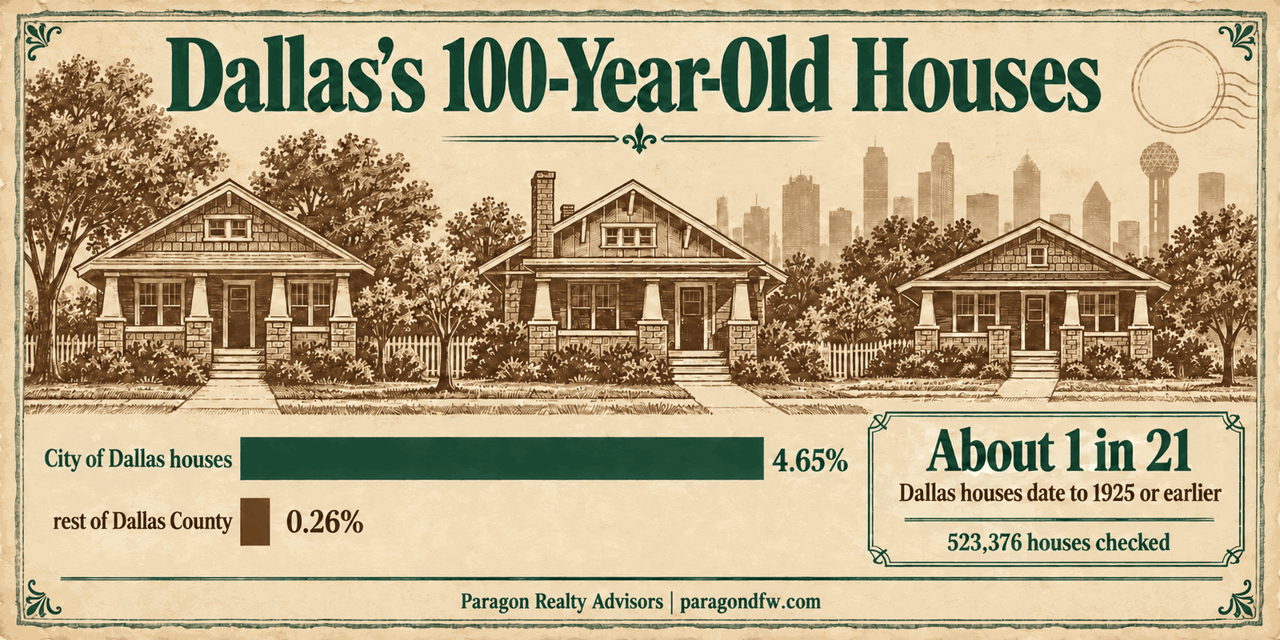
- The City of Dallas is where the old houses are. About 1 in 21 houses there dates to 1925 or earlier, against about 1 in 385 in the rest of Dallas County.
- Oak Cliff and the neighborhoods near it lead. In 75208 and 75223 about one house in three is that old, and in 75215 roughly one in four.
- The old houses sit in clusters, down to single blocks. Some short streets in 75214 are entirely made up of them, though each has only a handful of houses.
- The newest ZIPs have almost none, and some have not a single one.
- The cutoff is soft. Recorded years pile up at 1925, so we round ZIP shares and say "about 100 years or older". The same ten ZIPs make the top ten when we move the cutoff a year either way; their order shifts.
- If you own or want an old house, the useful questions are about the city's historic rules, inspections and the roof, wiring and plumbing. We list them near the end.
How We Counted
DCAD is the Dallas Central Appraisal District, the county office that values every property for tax purposes. It publishes its appraisal data files each year, and we used the 2026 current data. We kept DCAD's single family house category, which gave 524,074 properties. We dropped 698 whose recorded year built was blank, zero, before 1880 or after 2026, which left 523,376 houses. Each house counts once. Where DCAD lists more than one structure on a property, we use the one with the largest main living area, so a guest house or garage apartment does not stand in for the house.
A century home in this post is a house with a recorded year built of 1925 or earlier. A house recorded as built in 1926 turns 100 this year, so strictly our line catches homes that are 101 or older. Because the recorded years are rough, we say "about 100 years or older" and do not claim an exact age line.
The City of Dallas means houses where DCAD lists the property city as Dallas. The rest of Dallas County means every other property city in the county, including Garland, Irving, Mesquite, Grand Prairie and the small cities. DCAD covers Dallas County only, so the parts of the City of Dallas that sit in Collin and Denton counties are not in this count.
A ZIP code is ranked only if it has at least 200 houses, which gave 81 ZIPs. A street is ranked only if it has at least 10 houses in one ZIP, which gave 14,344 street-and-ZIP pairs. A street that runs through two ZIPs is two entries, so "Worth St" in 75214 and "Worth St" in 75246 would be different lines. We never show an individual house. We show no owner names and no values of any kind.
A median is the middle value: half the houses are older, half newer.
The Big Picture: The Old Houses Are in the City
Across Dallas County, 10,898 of 523,376 houses were recorded as built in 1925 or earlier. That is 2.08 percent, or about 1 house in 48.
Almost all of them are in the City of Dallas. Of 216,956 City of Dallas houses, 4.65 percent date to 1925 or earlier. Of 306,420 houses in the rest of the county, 0.26 percent do. Put in a unit you can feel, a house in the city is about 18 times as likely to be that old as a house elsewhere in the county.
Turn the shares into counts and the same story appears. About 10,100 of the 10,898 are inside the city, and about 800 are everywhere else. That is more than nine in ten.
The typical house tells it too. The median year built is 1960 in the City of Dallas and 1982 in the rest of the county, a 22 year gap. For the county as a whole it is 1974.
Which ZIP Codes Lead?
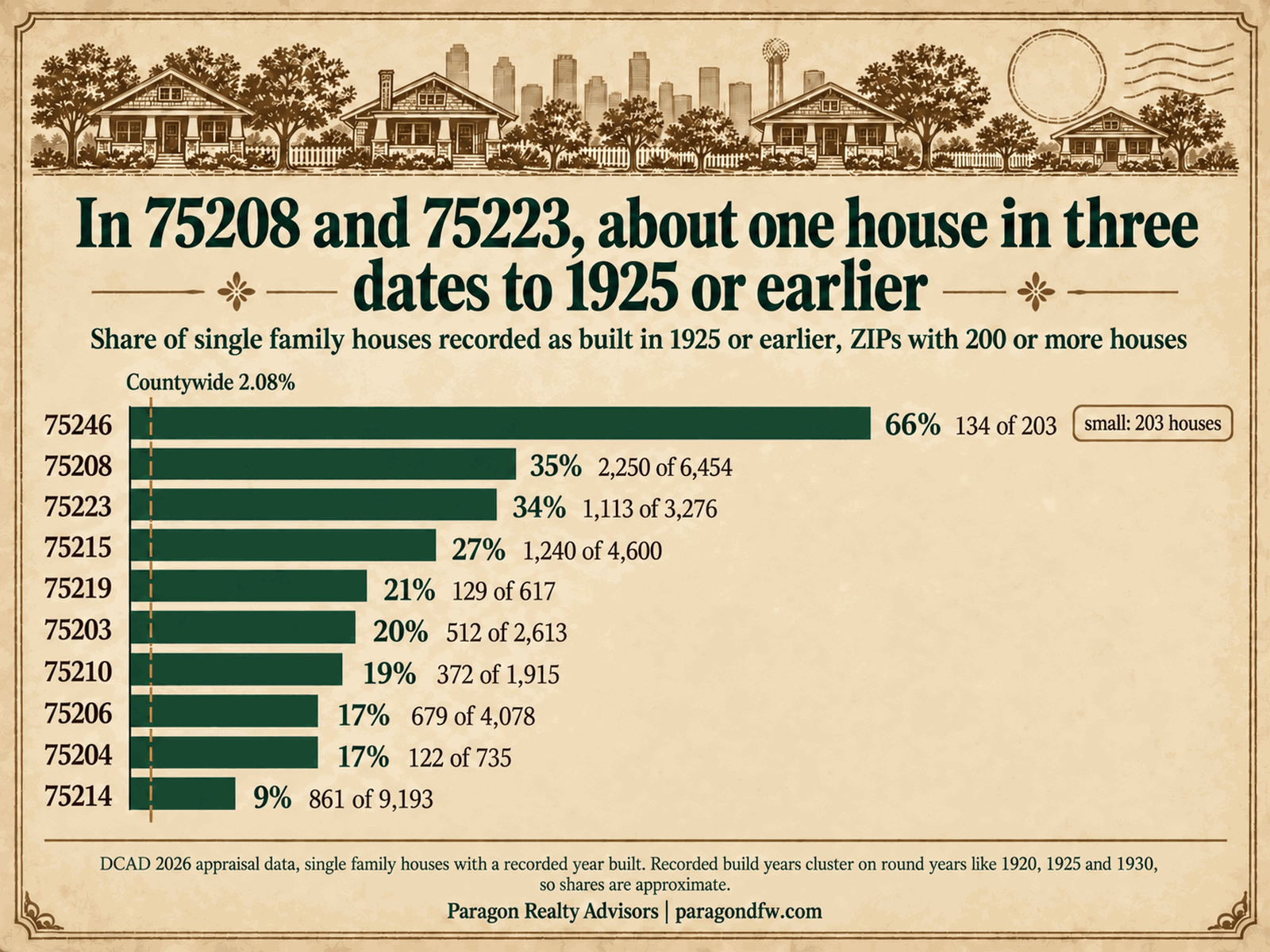
In 75208 and 75223, about one house in three dates to 1925 or earlier. Source: Dallas Central Appraisal District 2026 current appraisal data, single family houses with a recorded year built; ZIPs with at least 200 houses, ranked by share built in 1925 or earlier. The dashed marker is the countywide 2.08 percent. 75246 has only 203 houses.
Here are the ZIPs with the highest share of houses built in 1925 or earlier. We list the number of houses beside each, because a share of a tiny ZIP means less than a share of a big one.
75246 is first by share, at about two houses in three (134 of 203). It is also small, with 203 houses, so we treat it as a pocket and not as a neighborhood.
75208, which covers much of Oak Cliff, is the large ZIP to watch. About a third of its houses (2,250 of 6,454) are that old. It also has the most century homes of any ZIP in the county, and the median house there was recorded as built in 1930.
75223 is next at about a third (1,113 of 3,276). 75215 follows at roughly one in four (1,240 of 4,600).
Then comes a group around one in five, 75219 (129 of 617), 75203 (512 of 2,613) and 75210 (372 of 1,915). After that, 75206 (679 of 4,078) and 75204 (122 of 735) sit near one in six, and 75214 (861 of 9,193) is about one in ten.
The ZIP with the most old houses by raw count is 75208, then 75216 (1,333), 75215 (1,240) and 75223 (1,113). 75216 is a big ZIP, so its 1,333 old houses make up only about 1 in 11 of its 15,233 houses.
Does the ranking hold up? Yes. Because the recorded years pile up at 1925 (see below), we re-ran the top 10 with the cutoff moved one year earlier and one year later. The same ten ZIPs appear in the top ten both times. The shares move, and so does the order within the ten, which is why we round them.
The Quiet End of the List
For contrast, here are the ZIPs with the youngest typical house. Among the 81 ZIPs we ranked, 75039 in Irving has a median year built of 2012 and not one house from 1925 or earlier (0 of 1,602). Sunnyvale's 75182 has a median of 2005 and 3 century homes in 2,465. Glenn Heights' 75154 has a median of 2004 and 2 in 2,870.
Which Streets Have the Most?
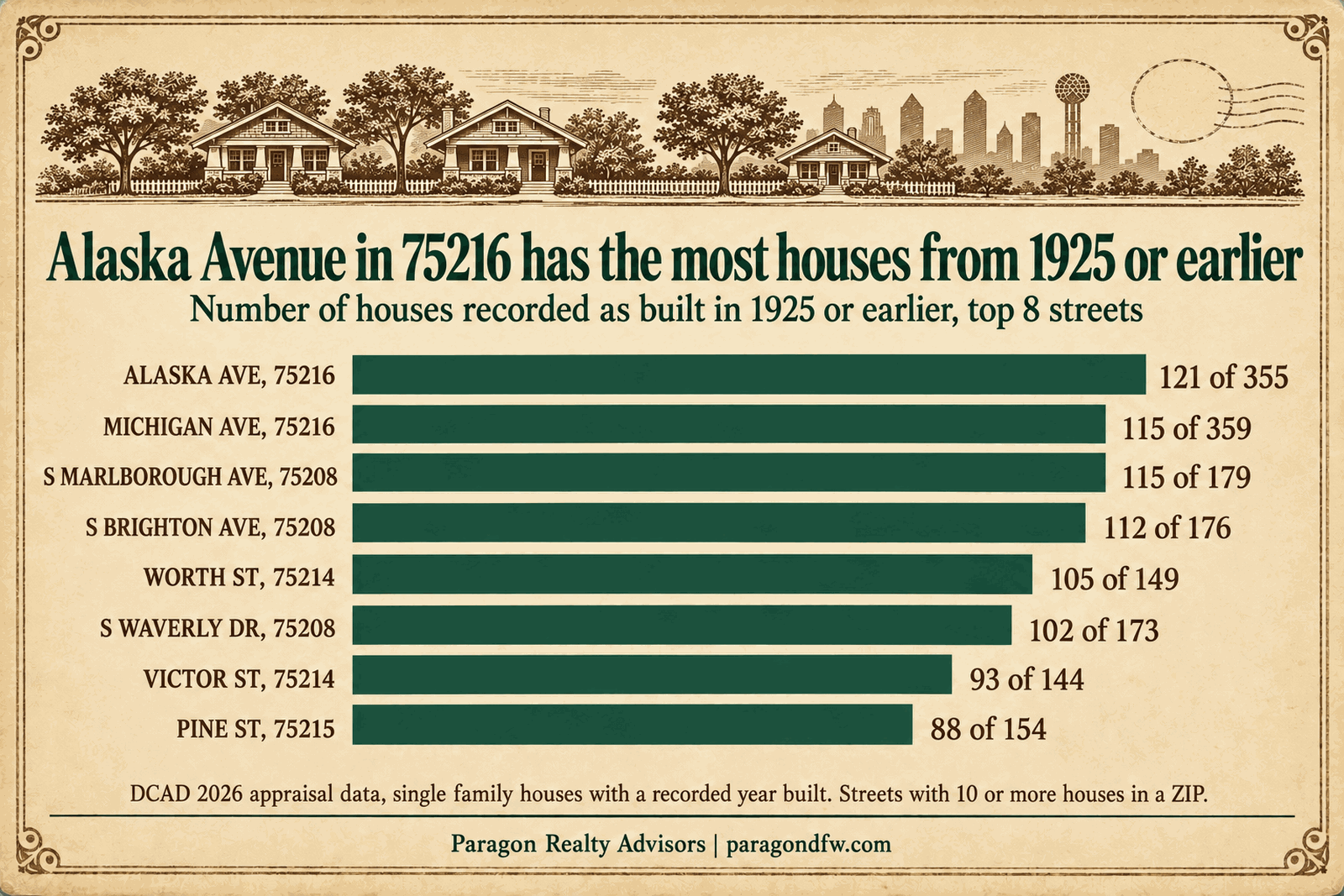
Alaska Avenue in 75216 has the most houses from 1925 or earlier, 121 of 355. S Marlborough Avenue and S Brighton Avenue in 75208 have the highest share among the biggest, about 64 percent. Source: Dallas Central Appraisal District 2026 current appraisal data, single family houses with a recorded year built; streets with at least 10 houses in a ZIP, ranked by number built in 1925 or earlier. Street and ZIP shown together.
We ranked streets by the raw count of houses built in 1925 or earlier, which surfaces the long streets where the history is a big block.
Alaska Avenue in 75216 has the most, with 121 of its 355 houses (about one in three). Michigan Avenue in 75216 has 115 of 359. These two have a typical house built around 1940 or 1941, so they are mixed streets with a large old section, not wall-to-wall old.
The streets where old houses are the clear majority are in 75208. S Marlborough Avenue has 115 of 179 (about 64 percent), and S Brighton Avenue has 112 of 176 (about 64 percent). The median house on both was recorded as built in 1924 or 1924.5. Next in 75208 are S Waverly Drive (102 of 173), N Clinton Avenue (88 of 151) and S Oak Cliff Boulevard (88 of 172). N Winnetka Avenue (88 of 180) and N Windomere Avenue (76 of 155) are also on the list, at roughly half.
In 75214, Worth Street has 105 old houses out of 149, which is 70 percent. Victor Street has 93 of 144. Swiss Avenue in 75214 has 85 of 103, or about 83 percent, which is the highest share of any street in the county with 100 or more houses.
Some of these streets may fall inside a City of Dallas historic district. We did not match streets to district boundaries, so we do not say which. The city's district map is linked in Sources.
The Short Streets That Are 100 Percent
Of the 14,344 street-and-ZIP pairs with at least 10 houses, only 3 are made up entirely of houses built in 1925 or earlier. All three are in 75214. Each is tiny:
Street (ZIP) | Houses in 2026 data | Built in 1925 or earlier |
|---|---|---|
Lipscomb Ave (75214) | 14 | 14 |
Lowell St (75214) | 13 | 13 |
Glendale St (75214) | 11 | 11 |
Two more short streets come close, Nesbitt Drive and Skillman Street, with 13 of 14 each. With 11 to 14 houses, "100 percent" describes one short block, and a single house changes it.
Why the Old Houses Cluster: A Look at the Years
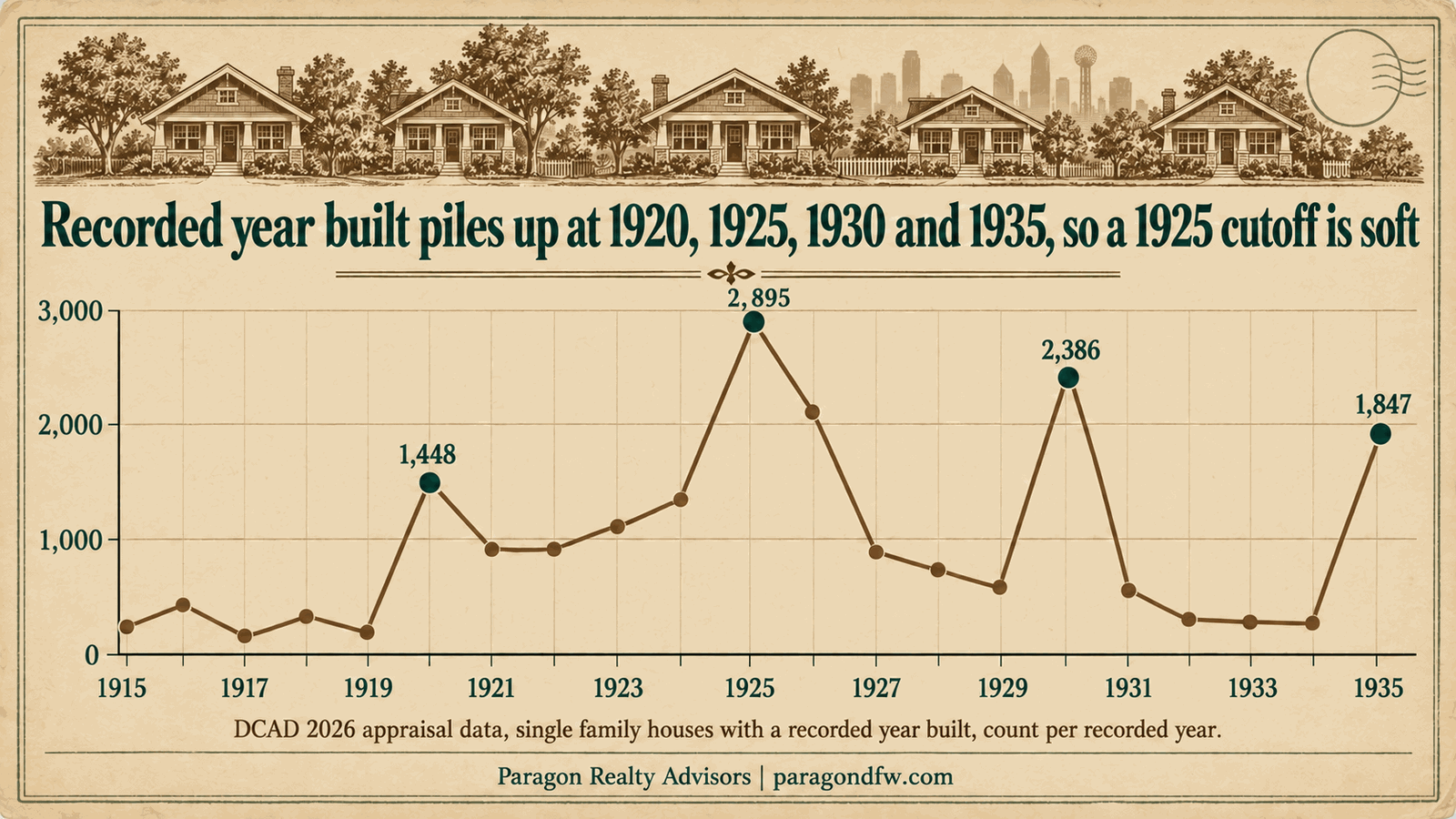
Recorded year built piles up at 1920, 1925, 1930 and 1935, so a 1925 cutoff is soft. Source: Dallas Central Appraisal District 2026 current appraisal data, single family houses with a recorded year built, counts for each year from 1915 to 1935.
Zoom out to the whole county and the decade counts show how the stock was built. The 1910s have 2,082 houses on the roll, and the 1920s have 12,825, about six times as many. The 1940s have 33,971, and the 1950s have 92,099, the biggest decade in the county at about 17.6 percent of all houses. Only 7.75 percent of the county's houses, 40,541, date to 1945 or earlier.
That is the shape: a thin early layer, a bump in the 1920s, and a very large post-war block. We do not explain why Dallas built when it did.
The 1925 Problem
Now the caution. The chart above counts houses by their recorded year, and the counts do not rise smoothly. They pile up at round years.
In the 1920s, 1925 has 2,895 houses, while 1924 has 1,305 and 1926 has 2,095. The two neighbors average 1,700, so 1925 is about 1.7 times the neighbors. The same thing happens at 1920 (1,448 against a neighbor average of 528), at 1930 (2,386 against about 556) and at 1935 (1,847 against about 693).
The cause is not in our data. It looks like rounding, but we cannot confirm that. What matters is that the 1925 line sits on one of the biggest pile-ups.
That makes shares near the line unstable. In 75208, the share built in 1925 or earlier is about 35 percent. Move the cutoff one year earlier, to 1924, and it reads about 25 percent. Move it one year later, to 1926, and it reads about 39 percent. The same test moves 75223 from about 30 to about 41 percent and 75215 from about 19 to about 33 percent. In 75206 the swing is larger still, from about 13 to about 29 percent.
So we round the ZIP shares, lean on the fact that the same ten ZIPs make the top ten at every cutoff (their order shifts), and say "about 100 years or older".
What Would Make This Wrong?
The record may not match the house. DCAD records one year built. That is the construction year on file for the main structure, not the year of a remodel, and it can be an estimate for very old homes. We have not checked individual records against permits or deeds.
We only count what is still standing. Houses already torn down are not on the 2026 roll, so a ZIP with a low share may once have been much older.
Old is not the same as protected. We did not match houses to the city's designations.
One year of data, single family only. This is one snapshot. Duplexes, condos and townhomes are not counted.
What holds up: the City of Dallas has far more houses from 1925 or earlier than the rest of the county, and the same ten ZIPs make the top ten at every cutoff we tried; their order shifts.
What It Means If You Own, or Want, an Old House
We are brokers, not preservation lawyers, so we keep this section to what the city says on its own pages, and to questions worth asking.
First, find out if you are in a historic district or have a landmark. The City of Dallas Office of Historic Preservation handles historic districts, landmark designation and the approvals that go with them, and its page links to a map of the districts and a spreadsheet of all designated structures and sites. The office's phone number on its pages is (214) 670-4206. Do this before you plan any exterior change.
Second, exterior work may need an approval. The city describes a Certificate of Appropriateness as the approval form for work on landmark structures, and applications go through the city's DallasNow system. Winnetka Heights, an Oak Cliff district, is a worked example. The city says it was platted in 1908, was Dallas's sixth historic district when adopted in 1981, and has more than 600 residential structures and 20 commercial structures on 50 city blocks. The city's page links to the district's ordinance, which holds the actual rules. We have not read those rules for you, so read them or ask the office before you replace windows, add on or paint. Other districts have their own ordinances.
Third, there may be a city tax benefit. The city says a property can qualify for a tax exemption for rehabilitation if it is a City of Dallas landmark or a contributing property in a Landmark District. The steps are an application to the Landmark Commission, a verification of expenditures when the work is done, and an annual application through DCAD. A 2016 city information packet says the exemption applies only to city taxes, not to county or school taxes, and that it is not a cash grant. That packet is dated, so confirm the current rules. We give no dollar amounts because we have none to verify.
Fourth, demolition may be delayed. The city says a building that meets certain criteria in a demolition overlay district is subject to a 45 day delay before a demolition permit can be granted. That is a delay, not a ban.
Fifth, the questions we would ask on any house of this age. We are not asserting anything about every old house here. These are the questions to put to an inspector or an insurance agent early:
- Which of the roof, electrical, plumbing and foundation are original, and which have been replaced? Ask for the dates.
- What does the home inspection say about the structure and the foundation, and is a specialist worth hiring?
- What will an insurance agent need to know about the house's age and updates, before you commit to buying or renovating?
- If a permit is needed for the work you plan, which office issues it, and does the street have special rules?
The Reference Table: Look Up Your ZIP
Find your ZIP below. The first column of numbers is the line we used (1925 or earlier). The last two show what happens if the line moves a year.
ZIP | Houses | Built 1925 or earlier | Share (1925 or earlier) | Share, 1924 line | Share, 1926 line | Median year built |
|---|---|---|---|---|---|---|
75246 | 203 | 134 | 66% | 65% | 67% | 1920 |
75208 | 6,454 | 2,250 | 35% | 25% | 39% | 1930 |
75223 | 3,276 | 1,113 | 34% | 30% | 41% | 1931 |
75215 | 4,600 | 1,240 | 27% | 19% | 33% | 1935 |
75219 | 617 | 129 | 21% | 15% | 23% | 1945 |
75203 | 2,613 | 512 | 20% | 10% | 21% | 1945 |
75210 | 1,915 | 372 | 19% | 13% | 23% | 1947 |
75206 | 4,078 | 679 | 17% | 13% | 29% | 1940 |
75204 | 735 | 122 | 17% | 14% | 18% | 1980 |
75214 | 9,193 | 861 | 9% | 8% | 11% | 1956 |
75216 | 15,233 | 1,333 | 9% | 6% | 10% | 1950 |
75211 | 12,649 | 683 | 5% | 3% | 8% | 1949 |
Notice 75206, where the share runs from about 13 percent at the 1924 line to about 29 percent at the 1926 line, more than double. That is the soft cutoff at work.
The Paragon Angle
Here is our read. It is a broker's read, not a historian's.
First, a house of this age is a different kind of purchase from one built in 2005. The records say the house is old. They do not say what condition it is in. Some of these houses have been carefully kept up and some have not, and the year built alone cannot tell you which.
Second, location is the story. The old houses are packed into particular ZIPs and blocks, so compare a house against its own blocks, not the city.
Third, if you own on one of these streets, find out whether your block is a historic district before you plan exterior work. Learn it before the contractor shows up.
Fourth, if you love old houses, use the questions above and ask for the dates on the big systems.
Frequently Asked Questions
How many Dallas County houses were built in 1925 or earlier?
10,898 of 523,376 single family houses in DCAD's 2026 data, or about 2 percent. About 10,100 of them are in the City of Dallas. We call these "about 100 years or older" because the recorded years are approximate.
Which Dallas ZIP codes have the most old houses?
By share, 75246 is first but small (134 of 203), then 75208 and 75223 at about a third, and 75215 at roughly one in four. By count, 75208 has the most, at 2,250.
Is every 100-year-old house in Dallas historic or protected?
No. Age alone does not make a house a landmark or put it in a historic district, and we did not match houses to the city's designations. The City of Dallas Office of Historic Preservation can tell you whether your address is covered.
How do I check my own house?
Look your address up on the DCAD website (dallascad.org, "Find Property By Street Address") and see what the county has on file. Then check the city's historic district map. If the county's year looks wrong, that is worth a conversation with an inspector.
Conclusion: Old Dallas Is in the City, and on Particular Streets
We checked 523,376 Dallas County houses. Of those, 4.65 percent in the City of Dallas date to 1925 or earlier, against 0.26 percent in the rest of the county. The old houses cluster in Oak Cliff and nearby ZIPs (75208, 75223, 75215), and on a few long streets in 75208 and 75216.
The 1925 line is soft, so we kept ZIP shares to round figures. What holds is the list: the same ten ZIPs make the top ten at every cutoff, though their order shifts. Look up your street, then check the city's rules before you change anything.
Talk to Paragon
If you own or are thinking of buying an older Dallas house, we can pull what the records show for your street.
Email: [email protected]
Phone: (469) 290-7593
Online: paragondfw.com/contact
Related Articles
- We Mapped 301,062 DFW Home Sales. Go Find Your Neighborhood.
- Does One Landlord Own Half Our Street? In Dallas County, Owners With Ten or More Houses Hold 2.5 Percent of Parcels
- Dallas Paid to Count Its Trees. We Counted the Listings.
Sources
- Dallas Central Appraisal District, 2026 current appraisal data files (DCAD2026_CURRENT), single family residence category, year built field: https://www.dallascad.org (Data Products). Paragon data card for newsletter 0018, `oldest_homes.json`, built by `oldest_homes.py`.
- Method: 524,074 single family properties; 698 excluded for a blank, zero, pre-1880 or post-2026 year; 523,376 used. Main structure is the improvement with the largest main living area. Century cutoff is a recorded year of 1925 or earlier. ZIPs with at least 200 houses ranked (81); streets with at least 10 houses in a ZIP ranked (14,344). Sensitivity cuts at 1924 and 1926.
- DCAD, "Find Property By Street Address": https://www.dallascad.org/SearchAddr.aspx
- City of Dallas Office of Historic Preservation: https://dallascityhall.com/departments/sustainabledevelopment/historicpreservation/Pages/default.aspx (Certificates of Appropriateness, DallasNow applications, tax incentive program, district map and designation spreadsheet).
- City of Dallas, Winnetka Heights historic district page (platted 1908, adopted 1981, more than 600 residential structures, 50 blocks): https://dallascityhall.com/departments/sustainabledevelopment/historicpreservation/Pages/winnetka_heights.aspx
- City of Dallas, Historic Tax Incentives (landmarks and contributing properties; Landmark Commission and DCAD steps): https://dallascityhall.com/departments/sustainabledevelopment/historicpreservation/Pages/tax_incentives.aspx
- City of Dallas, Historic Tax Incentives information packet for applicants, revised September 7, 2016 (city taxes only; dated, confirm current rules): https://dallas.gov/departments/sustainabledevelopment/historicpreservation/HP%20Documents/Tax/0_Tax%20Incentives%20-%20Information%20Packet%20for%20applicants%20-%20rev%209-7-2016.pdf
- City of Dallas, Historic Buildings page (45 day demolition delay in demolition overlay districts): https://dallascityhall.com/departments/sustainabledevelopment/historicpreservation/Pages/historic-buildings.aspx
- City of Dallas, Dallas Historic Designations page (office phone number): https://dallascityhall.com/departments/sustainabledevelopment/historicpreservation/Pages/Dallas-Historic-Designations.aspx
- D Magazine, D Home fall 2026, "Dallas' 15 Must-Save Historic Homes" (hook; online September 8, 2026, updated October 12, 2026): https://www.dmagazine.com/publications/d-home/2026/fall/15-iconic-homes-worth-preserving/