Dallas hired a city planner in 1909. In 1911 the city's Park Board published his report, "A City Plan for Dallas." Most of what it proposed was not built at the time. His name, though, is on a group of neighborhoods in Oak Cliff, the part of Dallas southwest of downtown across the Trinity River, and one of them, Kessler Park, now carries two formal designations.
This is a neighborhood guide with a practical aim. It explains what Kessler Park's two designations mean if you own or buy a house there, what the housing stock looks like, and how its homes have traded against the rest of its ZIP code. Facts about history and rules come from the City of Dallas, the Texas Historical Commission or another named source. The market numbers come from our own MLS warehouse. The MLS is the multiple listing service, the shared database agents use to list homes and record sales.
One scope note before the rest. "Kessler Park" on a map and "Kessler" in an MLS subdivision field are not the same thing, and the market section explains exactly which homes we counted.
Key Takeaways
- Kessler Park has two separate designations: a National Register of Historic Places listing from 1994, and City of Dallas Conservation District 13, last adopted or amended in May 2005. They do different jobs.
- The conservation district is the one with teeth. The city says its rules act as zoning for the area, so exterior changes, additions and new structures go through review.
- The ZIP code around it is old. In 75208, about 1 house in 3 was built before 1926, against roughly 1 in 20 across the City of Dallas.
- Over the last 12 months, homes in Kessler-named subdivisions took a median of 34 days to sell, against 51.5 days for the rest of 75208, on a small sample of 54 closings.
- Check an address against the city's conservation district map before you plan any exterior work.
Who Kessler Was, and What the Name Is Doing Here
George E. Kessler was a German-born city planner. In 1909 the Dallas Chamber of Commerce created a group called the City Plan and Improvement League, later renamed the Kessler Plan Association, and hired him to draft a long-range plan of civic improvements. The plan aimed at three problems: flooding along the Trinity River, dangerous railroad crossings, and narrow, crooked downtown streets. The archives record that the plan was not carried out at the time because it was not seen as practical, though changes were clearly needed. The Trinity River was improved and its levee system completed in the 1930s.
Kessler moved to St. Louis in 1910, came back to Dallas as a consultant in 1918, left again on January 3, 1922, and died in Indianapolis on March 20, 1923. Several Oak Cliff neighborhoods have Kessler in their names. We could not find a City of Dallas page that explains the naming, and we did not find a record that Kessler personally laid out the streets, so we make no claim about either.
The more useful question for an owner is what governs the neighborhood today.
Two Designations That Sound Alike and Do Different Things
Kessler Park is listed on the National Register of Historic Places as the Kessler Park Historic District. The Texas Historical Commission's Atlas records the listing date as June 17, 1994, as part of a larger multiple property listing called the Historic and Architectural Resources of Oak Cliff, with a boundary increase listed separately on September 7, 1995. The Atlas gives the area of significance as architecture and lists three styles: Tudor Revival, Mission and Spanish Revival, and Bungalow and Craftsman. It describes the district as roughly bounded by Kidd Springs, Stewart, Oak Cliff, Plymouth, Interstate 30, Turner, Colorado and Sylvan.
A National Register listing is a federal recognition of a place's historic value. On its own it is honorific: it does not by itself tell a homeowner what they can paint, add or tear down.
The second designation does. The City of Dallas lists Kessler Park as Conservation District 13, in Council District 1, with the most recent adoption or amendment in May 2005, under Ordinance 25984. A conservation district is a local overlay. The city's materials describe the district's rules as becoming the zoning for the area, so new work within it must comply, and exterior changes, additions and new structures go through a conservation district review. The city's Kessler Park page states its purpose as conserving the neighborhood and protecting its architectural and cultural attributes.
We did not read Ordinance 25984, and the city page does not spell out the rules in text. So we will not tell you what is allowed on a specific lot. What we can say is the order of operations: before you buy a house here with a renovation in mind, get the conservation district rules and the boundary map from the city, and ask a planner at the city whether the project you have in mind needs review.
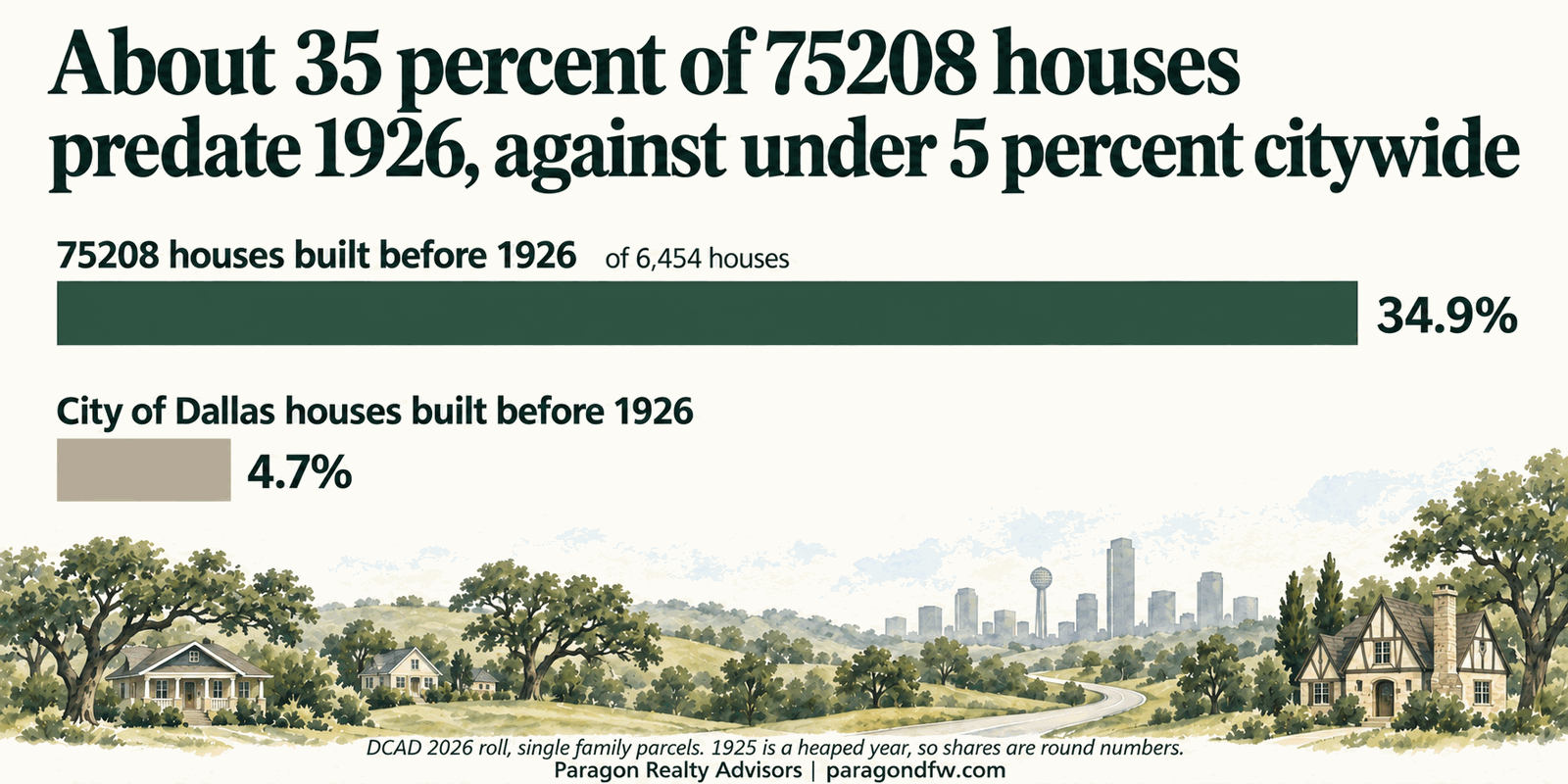
About 35 percent of 75208 houses were built before 1926, against under 5 percent across the City of Dallas. Source: Dallas Central Appraisal District 2026 roll, single family parcels, as tabulated for Paragon newsletter 0018. 1925 is a heaped year in the roll, so treat the shares as round numbers.
What the Houses Look Like
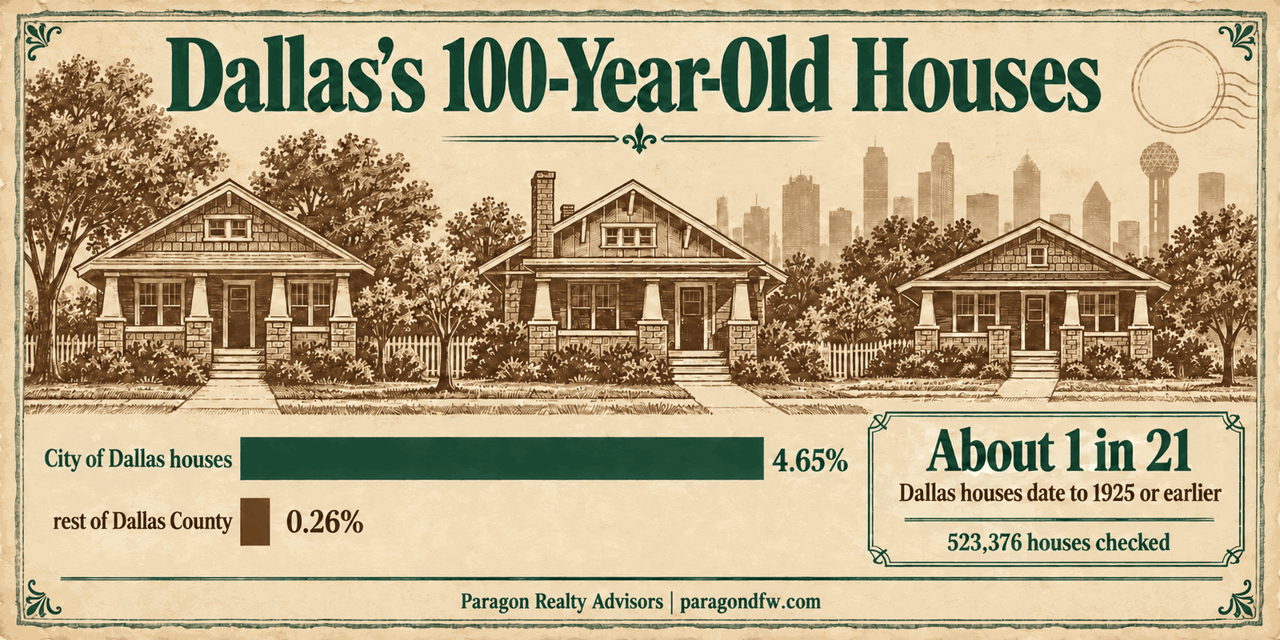
The overlays exist because of the age of the housing. Using the Dallas Central Appraisal District's 2026 roll, the county's property tax record, the median year built for the 6,454 single family houses in 75208 is 1930. About 35 percent of them, 34.86 to be exact, were built before 1926, against 4.65 percent of houses across the City of Dallas. That is about 7.5 times the citywide share. About 73 percent of the houses in 75208 were built before 1946.
One caution on the cutoff. The county roll has an unusual pile of houses recorded at exactly 1925, 2,895, against an average of about 1,700 across the two neighboring years (1,305 and 2,095), which may be rounding rather than a real building boom. Move the line one year earlier (built 1924 or earlier, the 1924 line) and the 75208 share drops to about 25 percent; move it one year later (built 1926 or earlier, the 1926 line) and it rises to about 39 percent. So the safe sentence is that roughly a quarter to two fifths of the ZIP's houses are a century old or close to it, and that this is far above the city. We use round numbers for that reason.
The houses carry a mixed bag of the things that come with age. Foundations, wiring, plumbing, roofs and original windows are the usual places age shows up in a house this old, and a buyer should have each of them inspected. We did not measure repair costs and publish none. The point of the section is the one the overlay answers: this is an old place, and the people who live here care how it changes.
Which Homes Count as "Kessler" in the Listings
This part matters for the numbers below, so we spell it out. In the MLS, every listing carries a subdivision name typed by the listing agent. Across 75208 over the last 24 months, closings fall under 43 different subdivision names that contain the word "Kessler." The biggest by closings are Kessler Square with 20, Kessler Park with 15, East Kessler with 11 and Kessler Highlands with 8, followed by West Kessler Heights with 5.
Our group is every residential listing in 75208 whose subdivision name contains "kessler," in any spelling. That is broader than the National Register district and the conservation district. Kessler Square, Kessler Highlands and East Kessler are separate subdivision names in the MLS, and some of the 43 names, such as Kessler West Townhomes, are townhome additions. We keep them together for one reason: over 24 months only Kessler Square reaches 20 closings. Treating them as one group gives 54 closings in the 12 months ending September 30, 2026 and 114 in the 24 months. Broken apart, nothing would be large enough to read.
The comparison group is the rest of 75208: 214 closings in the same 12 months. The caveat is built in. Our "Kessler" is a name filter, not the legal district. The overlay map and our group overlap a lot, but they are not identical, and an owner needs to check an address against the city's map, not against our group.
The Paragon Angle
Our read is that Kessler Park is a place where the paperwork is part of the property, and the sales record below looks different from the rest of the ZIP.
Start with the rules. If a buyer's plan is to keep the house and fix it, the overlay is a step to plan for, and it also protects the look of the street the buyer is paying to live on. If the plan is to tear down and build large, the rules are the first thing to read, before the offer, because they decide the project. Two buyers can bid on the same house for opposite reasons, and only one of them is in the right neighborhood.
Next, the ZIP. Roughly a third of 75208 was built before 1926, so many sellers are pricing houses with more history than any neighborhood average can capture. Price a house in Kessler against Kessler sales, not against the ZIP code and not against the city.
Third, the evidence from the sales record, which we show next. Kessler-named homes sold faster, cut price less often, and have less supply behind them than the rest of the ZIP. That is a read on the last 12 months. It describes what happened, not what a particular house will do.
Fourth, hire an inspector who has seen houses of this age, and ask the city which exterior changes need review before you promise a contractor a start date.
How Is the Market in Kessler Park?
All of the market figures in this post are in this section. They come from our NTREIS warehouse, medians only, windows stated. NTREIS is North Texas Real Estate Information Systems, the MLS for the region. Nothing here is a sale price. We use percentages, counts, ratios and days.
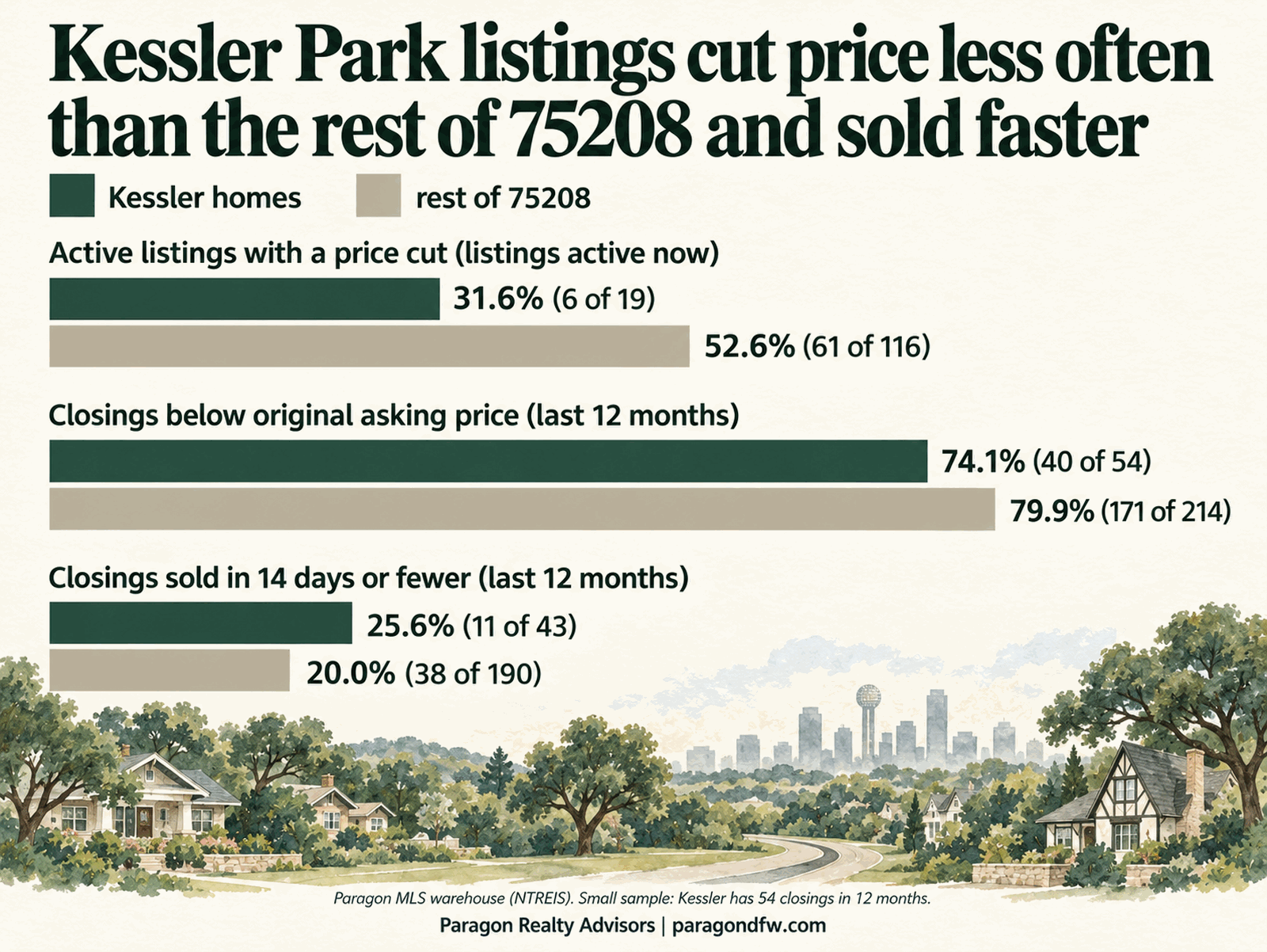
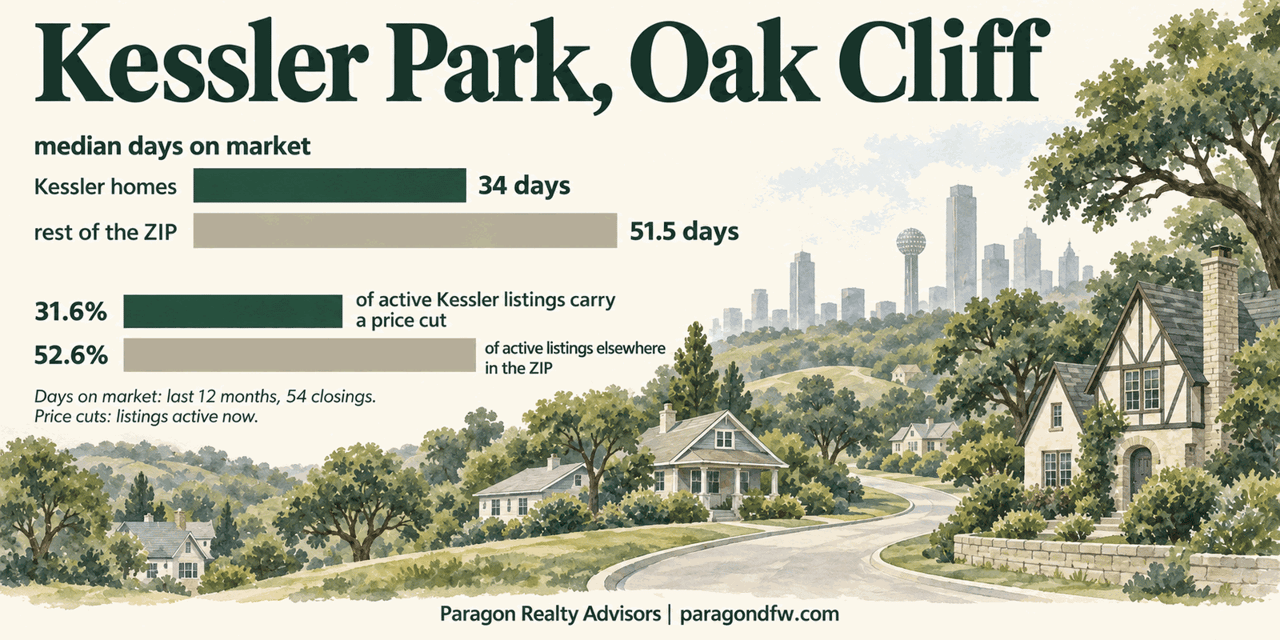
Kessler-named homes against the rest of 75208. 31.6 percent of active listings in the Kessler group carry a price cut, against 52.6 percent elsewhere in the ZIP. 74.1 percent of Kessler closings landed below the original asking price against 79.9 percent, and 25.6 percent (11 of 43 closings with a valid days-on-market figure) sold in 14 days or fewer against 20.0 percent (38 of 190). Source: Paragon MLS warehouse (NTREIS), residential closings October 1, 2025 to September 30, 2026; actives as of the warehouse read.
Speed. Among closed homes over the 12 months, the median days on market in the Kessler group was 34, against 51.5 in the rest of 75208, a gap of 17.5 days. Days on market here is cumulative days on market, the total days a home was for sale, adding repeat listings when the MLS links them. We use only values between 5 and 365 days, which left 43 of the 54 Kessler closings and 190 of the 214 others. About one in four Kessler closings with a valid days-on-market figure, 25.6 percent (11 of 43), sold in 14 days or fewer, against 20.0 percent (38 of 190) elsewhere.
Negotiation. Kessler homes still sold below the first asking price most of the time: 74.1 percent, or 40 of 54, against 79.9 percent, or 171 of 214, for the rest of the ZIP. The median closing price came to 95.9 percent of the original asking price in the Kessler group and 95.2 percent elsewhere, a gap of 0.7 points. That is small. The speed gap is much bigger than the price gap, which suggests buyers moved faster, not that sellers got a different deal.
Supply. Months of supply is how long the current homes for sale would last at the current pace of sales. We count the 19 Kessler-group listings that were active at the warehouse read and divide by the monthly pace of the last 90 days, 16 closings or about 5.3 a month. That gives about 3.6 months. For the rest of 75208 it is 117 actives against 52 closings in 90 days, or 17.3 a month, about 6.75 months. Six months is the usual line for a balanced market, so the Kessler group is tight and the rest of the ZIP is a little slack. The active count is as of the warehouse read in October 2026, not a September 30 snapshot.
Price cuts. Of the active listings, 6 of 19 in the Kessler group carry a price cut since listing, 31.6 percent. In the rest of the ZIP it is 61 of 116, 52.6 percent. A cut is a current list price below the original list price.
Age of what sold. Looking at the 24 months of closings to get a bigger sample, the median year built is 1940 in both groups. The difference is at the old end. Only 8.8 percent of the Kessler closings, 10 of 114, were built before 1926, against 29.9 percent of the others, 124 of 415. Kessler closings are weighted to the middle decades: 76.3 percent were built before 1960 against 68.2 percent. In plain terms, the oldest houses that sold were mostly outside the Kessler group. Kessler's houses are old by Dallas standards, but mostly from the middle of the last century, and that matters when you compare them to a 1910s bungalow elsewhere in the ZIP.
Full list, for reference.
Measure | Kessler-named subdivisions | Rest of 75208 |
|---|---|---|
Closings, 12 months | 54 | 214 |
Closings, 24 months | 114 | 416 |
Median days on market | 34 | 51.5 |
Sold in 14 days or fewer (of closings with valid days on market: 11 of 43; 38 of 190) | 25.6% | 20.0% |
Closings below the original asking price | 74.1% | 79.9% |
Median closing price as share of original ask | 95.9% | 95.2% |
Active listings carrying a price cut | 31.6% | 52.6% |
Months of supply | 3.56 | 6.75 |
Median year built, 24 months of closings | 1940 | 1940 |
Built before 1926, 24 months of closings | 8.8% | 29.9% |
For a seller, the pattern says correctly priced Kessler houses found buyers quickly, but about three in four still closed below where they started. For a buyer, the first number on a Kessler listing was a starting position far more often than a clearing price, and the tight supply means a good house may not wait.
What Would Make This Wrong?
It is a small sample. Fifty four closings in a year means one unusual month can move a median. The 24 month counts, 114 against 416, help with age but not with the speed figures, which we only calculated for 12 months.
It is a name filter. The group is every 75208 listing with "Kessler" in the subdivision field. Agents type that field by hand, so a house in the district can be filed under another name, and some filed under Kessler may sit outside the overlay map.
It is a mix of home types. The group includes townhomes as well as older houses, and we did not separate them.
It is the active count as of one date. At a count of 19 active listings, a few listings could shift the share of cuts a lot.
It is one year. Nothing here is a trend. The gap in days on market may close or widen next window, and we have not promised a re-run date.
What holds up: the Kessler group looked tighter and faster than the rest of the ZIP on every measure we checked. We are confident in the direction and less confident in the size.
Frequently Asked Questions
Is Kessler Park a historic district?
It is a National Register historic district, listed June 17, 1994, with a boundary increase on September 7, 1995. It is also City of Dallas Conservation District 13, which is a different kind of overlay and the one that governs exterior changes. The two are separate designations.
What is a conservation district in Dallas?
It is a local overlay whose rules become the zoning for the area. The city describes exterior changes, additions and new structures as going through a conservation district review. The specific rules are in the district's ordinance, which for Kessler Park is Ordinance 25984, and the city can tell you whether a project needs review.
Who was George Kessler?
He was a German-born city planner whom the Dallas Chamber of Commerce hired in 1909 to draft a long-range civic plan, published by the Park Board as "A City Plan for Dallas" in 1911. He left Dallas for good in 1922 and died in 1923.
How old are the houses in Kessler Park?
For the whole of 75208, the county record shows a median year built of 1930, with roughly a quarter (built 1924 or earlier) to two fifths (built 1926 or earlier) of houses that old, depending on the cutoff. Among the Kessler-named homes that sold in the last 24 months, the median year built was 1940.
Did homes sell faster in Kessler than the rest of 75208?
In our data, yes. Over the 12 months ending September 30, 2026, the median was 34 days on market in the Kessler group and 51.5 days in the rest of the ZIP. The sample is 54 Kessler closings, so read it as a pattern.
Conclusion: Read the Rules, Then the Numbers
Kessler Park is easy to describe and harder to buy well. It is an old part of Dallas with a planner's name on it, a federal listing from 1994 that honors its architecture, and a city conservation district last adopted or amended in 2005 that governs what you can change. Those are the two documents to read before the first showing.
The sales record says the market has treated the place well over the last year. Kessler-named homes sold in 34 days at the median against 51.5 for the rest of 75208, cut price less often, and had about 3.6 months of supply against about 6.75. They also still closed below the first asking price about three times in four. The honest summary is a tight neighborhood where buyers still negotiate.
If you own here, the question to answer before you list is which comparison set your house belongs to, and whether the overlay helps or limits the buyer you want. If you are buying, the question is what you plan to change, and whether the city will agree.
Talk to Paragon
If you want the numbers for your own street, or want help checking an address against the conservation district map before you make an offer, we are glad to pull it.
Email: [email protected]
Phone: (469) 290-7593
Online: paragondfw.com/contact
Related Articles
- White Rock Lake and East Dallas: The Lake Is the Whole Argument, and the Two ZIP Codes Around It Move at Different Speeds
- Does One Landlord Own Half Our Street? In Dallas County, Owners With Ten or More Houses Hold 2.5 Percent of Parcels
- The 380 Scorecard: Twenty Projects Were Promised on This Corridor. Six Are Open.
Sources
- Paragon MLS warehouse (NTREIS), 75208 residential listings with a subdivision name containing "kessler," closings October 1, 2025 to September 30, 2026 (12 months) and October 1, 2024 to September 30, 2026 (24 months); actives as of the October 2026 warehouse read. Paragon data card for newsletter 0018, `kessler.json`. Based on information from the North Texas Real Estate Information Systems, Inc. Data deemed reliable but is not guaranteed accurate by the MLS or NTREIS.
- Days on market is NTREIS cumulative days on market, values between 5 and 365 days kept. Price ratio is the closing price divided by the original list price, closed listings only, quarantined original prices excluded, reported as a ratio with no dollar figures.
- Months of supply: active listings at the warehouse read divided by closings in the 90 days ending September 30, 2026, divided by 3.
- Dallas Central Appraisal District, 2026 bulk roll, single family parcels, year built, as tabulated in Paragon's oldest homes study for newsletter 0018 (`oldest_homes.json`). 1925 is a heaped year; shares are reported as round numbers with a 1924 line and 1926 line sensitivity.
- City of Dallas Municipal Archives, George E. Kessler collection finding guide 91-004, for the 1909 hiring, the City Plan and Improvement League, the 1911 report "A City Plan for Dallas," his later dates, the plan's three problems and the 1930s Trinity levee completion: https://dallascityhall.com/government/citysecretary/archives/Pages/Archives_1991-004.aspx
- City of Dallas Planning and Development, Kessler Park Conservation District 13 page, for the council district, the May 2005 adoption or amendment, Ordinance 25984 and the stated purpose: https://dallascityhall.com/departments/pnv/Pages/KesslerPark.aspx
- City of Dallas, "Introduction to Conservation Districts" and "What is a Conservation District?" explainers on dallascityhall.com, for the description of the rules acting as zoning and the review of exterior changes. The Kessler Park ordinance text itself was not read.
- Texas Historical Commission Atlas, Kessler Park Historic District (Atlas number 2094000607, listed June 17, 1994) and boundary increase (Atlas number 2095001087, listed September 7, 1995), for the listing dates, styles and boundary description: https://atlas.thc.texas.gov/Details/2094000607
- Method note: the counts and shares here are counts and shares, not prices. Every market figure sits in one section, and no dollar figure appears anywhere in this post.