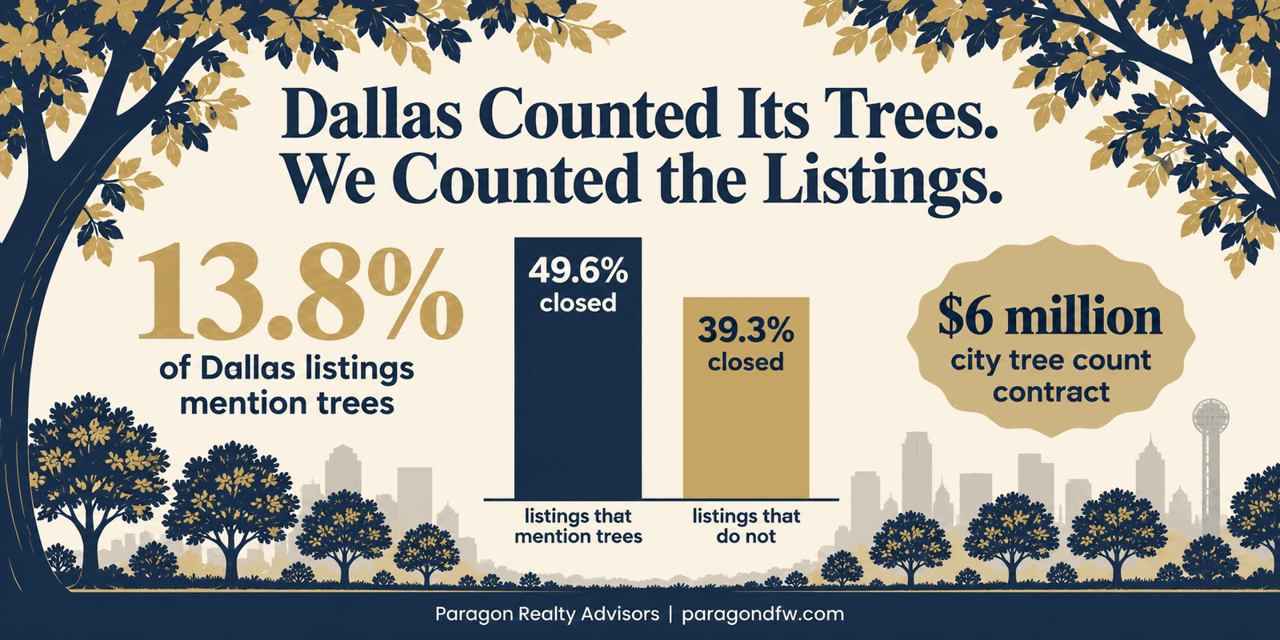
In 2024 the Dallas City Council approved a $6 million contract to inventory every tree in the city's parks and on city-owned land. The count is partly paid for by a U.S. Forest Service grant, the contractor is Davey Tree, and the work was prompted by the emerald ash borer, a beetle that kills ash trees. That count covers public land, not private yards.
We wanted to know something smaller. Do trees show up in the way homes are sold, and what do those homes look like in the sales record?
So we read the listings: every for-sale residential listing in the City of Dallas that came to market in the 12 months ending September 30, 2026, which is 17,907 listings. We looked for the words agents use when a tree is part of the pitch, such as "mature trees", "shade trees", "tree-lined", "live oaks" and "wooded lot", and compared the homes that mention trees with the homes that do not.
One caution comes first. This is an association. Homes that mention trees are also much older homes, and this data cannot pull the two apart. Nothing here says trees make a house sell. It says a certain kind of old, established Dallas home mentions trees and sells a bit differently, and it shows where those homes are.
Key Takeaways
- About 1 in 7 Dallas listings mentions trees: 13.8 percent of 17,907.
- Those listings closed more often: 49.6 percent have closed, against 39.3 percent of the rest.
- Among homes that closed, tree listings took a median of 31 days against 38.
- Closing price as a share of the original asking price was 97.0 percent against 96.7 percent, a small gap of about a third of a point.
- Tree listings are older homes: median year built 1968 against 1982. Age may explain much of what we see.
- The mentions cluster. In 75218 about 30 percent of listings mention trees. In 75215 it is 1.4 percent.
How We Counted
A listing that mentions trees is a for-sale listing in the City of Dallas, as the MLS labels it, whose public remarks contain at least one of these phrases: mature trees, shade trees, tree-lined, tree canopy, live oak(s), oak trees, pecan trees, towering trees, or wooded lot. The MLS is the multiple listing service, the shared database agents use to list and record sales. The public remarks are the paragraph an agent writes to describe a home.
We removed 31 listings whose match was part of a name, such as a subdivision called Oak Tree, and read a sample by hand. The method is crude. It may miss some tree homes (a listing that says "big oaks" is not in the group) and include a few that are not about trees.
The closed share is listings that closed, divided by all listings that came to market in the window. Active, expired and withdrawn listings count as not closed, in both groups. Only closings dated on or before September 30, 2026 count as closed, and status is as of our data pull in October 2026, not a September 30 snapshot. A listing that came out in September has had less time to close than one from October.
Days to sell is cumulative days on market (CDOM): the total days a home was for sale, adding repeat listings when the MLS links them. We use it for closed homes only and keep values between 5 and 365 days to drop data entry noise.
The City of Dallas here is the MLS city field, which includes pieces of Dallas in Collin and Denton counties. Counts cover every residential type: houses, townhomes and condos. We re-ran everything on single family houses alone; see the table below.
The Share: One Listing in Seven
Of the 17,907 listings, 2,469 mention trees, which is 13.8 percent, or about 1 in 7. Of those 2,469, 1,225 have closed. Of the other 15,438, 6,069 have closed. In a seller's units, that is about 10 more closed sales for every 100 listings.
A 95 percent confidence interval around the difference runs from about 8.2 to 12.4 points, so the gap is real in this sample. That says nothing about why it exists.
Counting only listings that reached a final outcome (closed, expired or withdrawn), so that still-active listings do not count against anyone, the gap holds: 66.4 percent of tree listings closed against 53.9 percent of the rest.
The Speed: About a Week Faster
Among homes that closed, tree listings took a median of 31 days on market and the rest 38, a gap of 7 days. A median is the middle value: half the homes sold faster and half slower. We use it because a few homes that sat for a year would drag an average up.
The days figures use 988 of the 1,225 closed tree listings and 5,203 of the 6,069 other closed listings, because we dropped values outside 5 to 365 days.
Measured against the original asking price, tree listings closed at a median of 97.0 percent and the others at 96.7 percent. That gap of about 0.3 points is small. The ratio compares the closing price to the first price the home was listed at. It cannot tell us whether a tree listing started higher or lower than a similar home, and this post publishes no price figures.
Where the Tree Listings Are
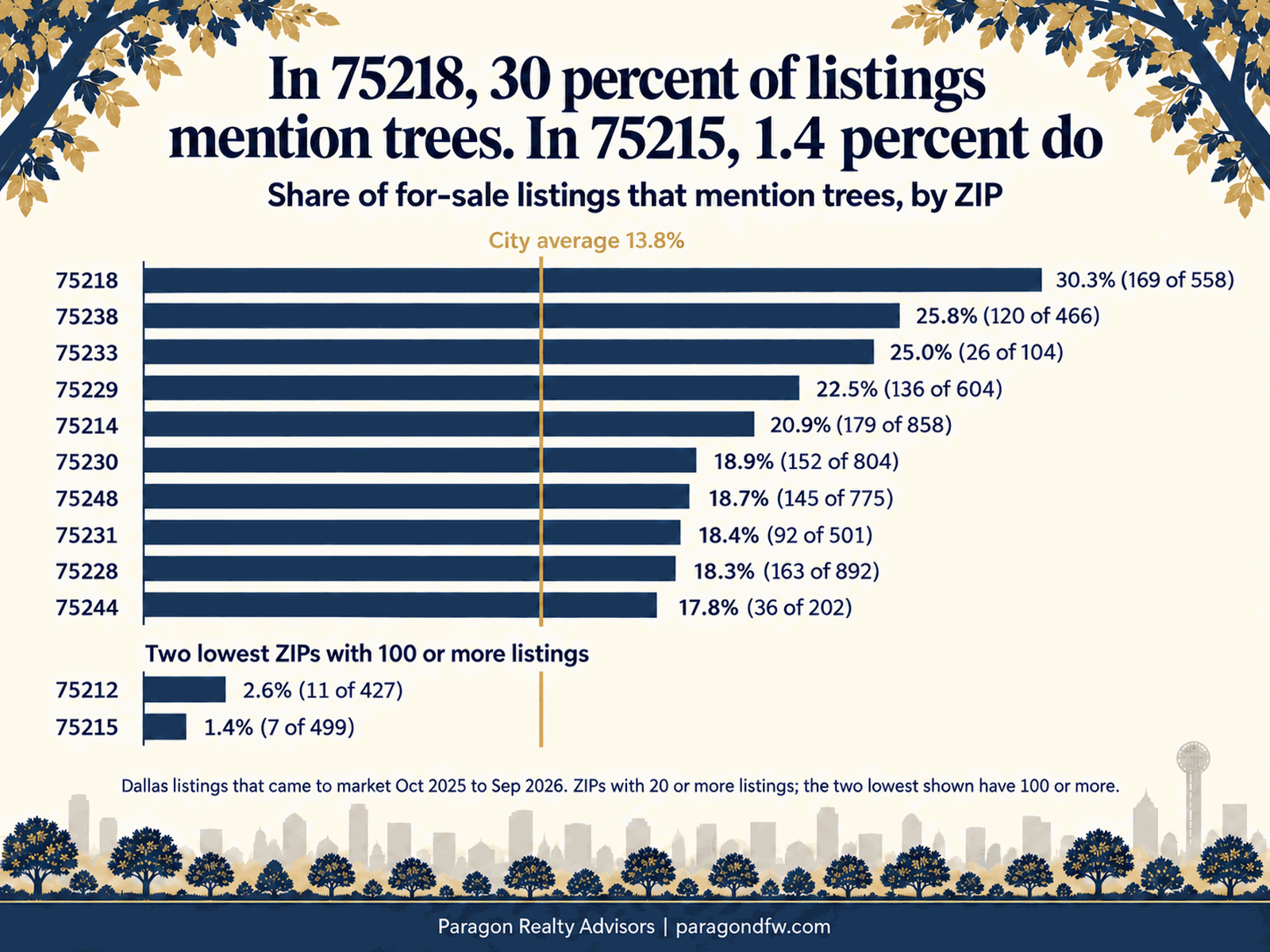
In 75218, 30.3 percent of listings mention trees. In 75215, 1.4 percent do. Source: Paragon MLS warehouse (NTREIS), City of Dallas for-sale residential listings that came to market October 1, 2025 to September 30, 2026. ZIPs with at least 20 listings are ranked; the two lowest shown have at least 100 listings.
The mentions cluster. In 75218, 169 of 558 listings mention trees, or 30.3 percent (counts from our saved data pull of October 2026). Next is 75238 at 25.8 percent (120 tree listings), then 75233 at 25.0 percent and 75229 at 22.5 percent.
Among ZIPs with at least 100 listings, the lowest are 75215 at 1.4 percent (7 of 499) and 75212 at 2.6 percent (11 of 427). Several smaller ZIPs show zero to 2.4 percent, but with 21 to 69 listings each we would not read much into them.
We ranked 46 ZIPs and suppressed 6 with fewer than 20 listings. Widening to the whole county, across Dallas County 12.6 percent of 33,841 listings mention trees, and those listings closed at 50.4 percent against 43.0 percent.
Mentions follow neighborhoods, not individual houses. That is a clue to what the word is standing in for.
Why Age Is the First Suspect
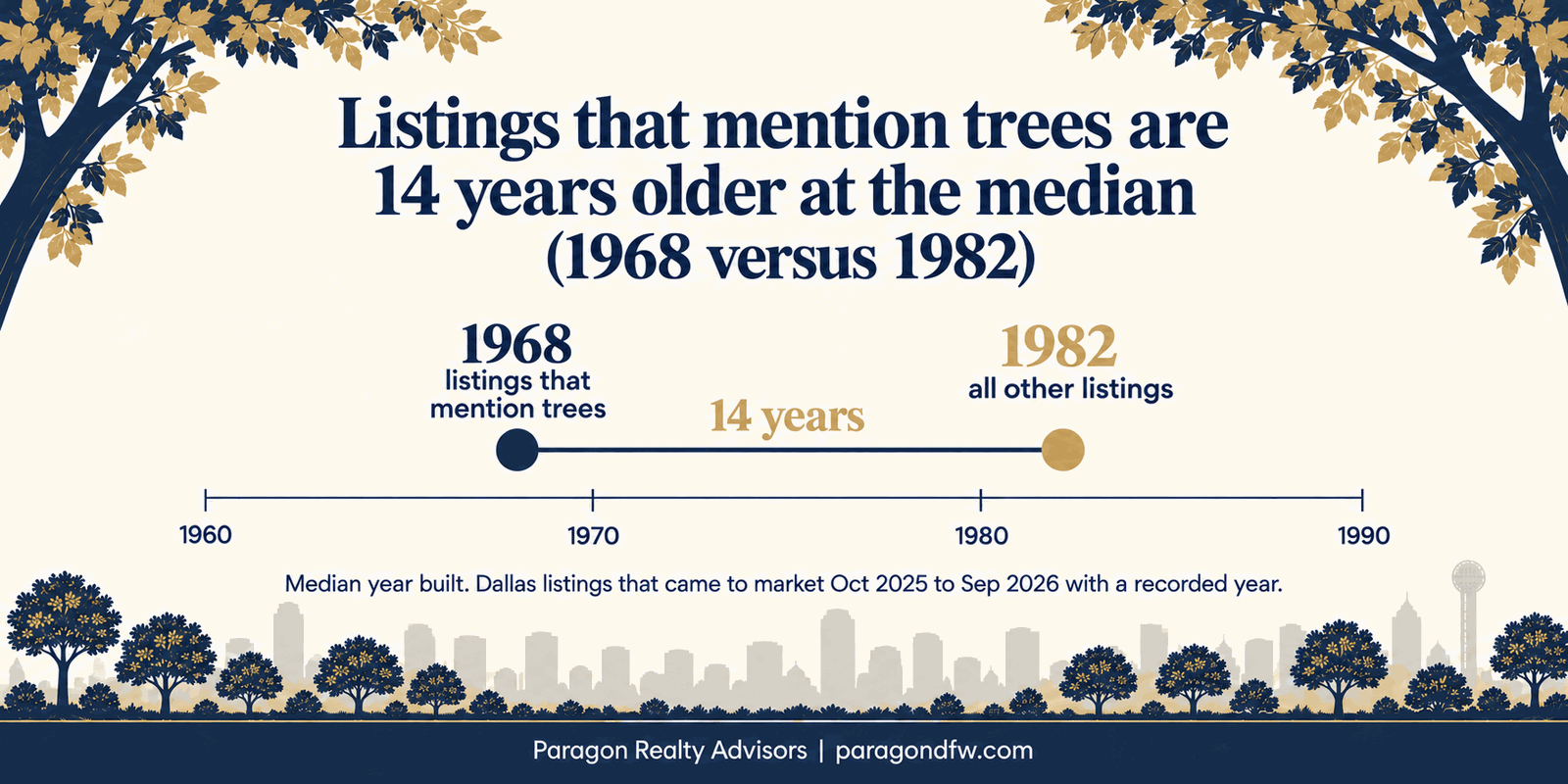
Listings that mention trees have a median year built of 1968, against 1982 for all other Dallas listings, a 14 year gap. Source: Paragon MLS warehouse (NTREIS), City of Dallas for-sale residential listings that came to market October 1, 2025 to September 30, 2026. Median year built, listings with a recorded year only.
Trees take decades to reach the size an agent calls mature. A house built in 1968 has had more than half a century of growth around it. So the word "mature" would be expected to track the age of the neighborhood, and it does: the median tree listing was built in 1968, the median other listing in 1982, a 14 year gap. On single family houses alone it is 1965 against 1978.
So "older, established neighborhood" sits right behind the trees in the data. A 1960s home in a settled part of town may sell differently for reasons unrelated to the oak in the yard: location, lot size, a renovation cycle, how many homes are for sale nearby.
Does Neighborhood Explain It? We Tested That Part
If tree listings simply sit in ZIPs where more homes close, their advantage should vanish when we compare each one with other listings in its own ZIP. So we reweighted the non-tree listings to match the ZIP mix of the tree listings. Taking non-tree listings in the same ZIPs, in the same proportions, 40.7 percent closed. The tree listings closed at 49.6 percent, so the gap shrinks from 10.3 points to about 8.9.
Most of the gap stays after matching for ZIP. But a ZIP is a big area, and what is left could still be age, size, condition, price tier, or the care an agent puts into a listing that describes the yard. This data cannot tell those apart.
The Reference Table
Measure | Tree listings | Other listings |
|---|---|---|
Listings (City of Dallas) | 2,469 | 15,438 |
Closed share of listings | 49.6 percent | 39.3 percent |
Median days to sell, closed homes | 31 | 38 |
Close as share of original asking price | 97.0 percent | 96.7 percent |
Median year built | 1968 | 1982 |
Single family only: share of listings that mention trees | 15.9 percent | |
Single family only: closed share | 52.5 percent | 42.8 percent |
Single family only: median days to sell | 30 | 36 |
Single family only: median year built | 1965 | 1978 |
Dallas County: closed share | 50.4 percent | 43.0 percent |
Dallas County: median days to sell | 30 | 35 |
Dallas County: median year built | 1971 | 1984 |
On every cut, tree listings close more often, sell sooner and are older. None of the cuts separates the trees from the age.
What Would Make This Wrong?
It could be age, not trees. We think this matters most. A median build year of 1968 against 1982 describes different housing stock.
It could be timing. Still-active listings count as not closed. If tree listings tend to come out earlier in the year, they have had more time to close. We did not check whether the two groups arrive on the same calendar, though the resolved-only comparison above is not affected by active listings.
It could be how the listing is written. Agents who describe a yard in detail may also price carefully and market hard. The words may mark effort, not trees. We cannot see effort.
It could be the phrase list. It may miss some tree homes and include a few that are not about trees. We have not read all 2,469 matches.
It could be one year. We cover 12 months. Nothing here is a trend.
What holds up: the gap persisted on single family houses, across Dallas County, and after reweighting to the same ZIP mix. We call this a real pattern with an unknown cause, which is more useful than a tidy story we cannot back up.
What Trees Might Cost That We Did Not Measure
We did not measure removal, trimming, root effects on a foundation, storm damage or insurance. Dallas also regulates removal. As of a 2023 City of Dallas presentation, trees 8 inches in diameter or larger are protected under Article X of the development code, and a removal permit generally is not required on a lot under two acres with a single family house or duplex, but is required on vacant lots, lots of two acres or more, and lots where a structure is being demolished. Rules change, so confirm with the city arborist before you cut anything large.
The Paragon Angle
Here is our read, and it is a broker's read, not a data scientist's.
First, do not price a house off the word "trees". Closing price against asking price was 97.0 against 96.7 percent, a small difference. What we can say is that homes with the word reached a closing more often, and a bit sooner, in this sample.
Second, if you own a house with real canopy, show it, and photograph it in the season it looks best. Whether the mention helps, or just comes with being an older, settled home, we cannot say.
Third, if you are a buyer who wants shade, use the word as a search filter, then check the cost side. Ask the inspector about trees near the slab and the age of the big ones. Mature trees come with the age of the home, and so do older roofs, systems and plumbing.
Fourth, the pattern is a neighborhood pattern: 75218 and 75238 sit at 30.3 and 25.8 percent while others sit near 1 or 2 percent. Price a house against the right comparable neighborhood, not the city average.
Frequently Asked Questions
Do trees make a Dallas house sell faster?
We cannot say that. Listings that mention trees closed about a week faster, a median of 31 days against 38, but those homes are also about 14 years older at the median. The data shows an association, not a cause.
Do homes with mature trees close closer to their asking price?
Slightly, in our data, but the gap is small. Tree listings closed at a median of 97.0 percent of their original asking price and other listings at 96.7 percent. This post does not compare dollar prices.
Which Dallas ZIP codes mention trees the most?
75218 leads at 30.3 percent of listings, then 75238 at 25.8 percent, 75233 at 25.0 percent and 75229 at 22.5 percent. Among ZIPs with at least 100 listings, 75215 is lowest at 1.4 percent, then 75212 at 2.6 percent.
How did you decide a listing mentions trees?
We searched each listing's public remarks for a fixed list of phrases such as mature trees, shade trees, tree-lined and live oaks, and removed 31 matches that were part of a subdivision or street name. We did not read every one of the 2,469 matches.
Conclusion: A Pattern in Old Neighborhoods
Dallas counted the trees on its own land. We counted the listings that talk about trees and found 13.8 percent do, concentrated in ZIPs such as 75218, 75238, 75233 and 75229. Those listings closed more often, 49.6 percent against 39.3, and about a week faster, 31 days against 38.
They are also 14 years older at the median. Matching on ZIP leaves a gap of about 8.9 points, so neighborhood is not the whole answer, but age and listing quality remain open.
The word "trees" flags an older, established part of Dallas, and those homes sold somewhat more readily over the last year. It does not tell you a price or promise a result. If you want the read for your own street, we can pull it.
Talk to Paragon
If you want the tree-and-sales picture for your own ZIP before you list or before you buy, we are glad to pull it.
Email: [email protected]
Phone: (469) 290-7593
Online: paragondfw.com/contact
Related Articles
- We Mapped 301,062 DFW Home Sales. Go Find Your Neighborhood.
- Does One Landlord Own Half Our Street? In Dallas County, Owners With Ten or More Houses Hold 2.5 Percent of Parcels
- Frisco Is Ranked the Number 1 Housing Market in America. Our Sold Data Tells a Different Story.
Sources
- D Magazine, "Dallas urban forest tree count," October 9, 2026: https://www.dmagazine.com/publications/d-magazine/2026/october/dallas-urban-forest-tree-count/ (hook: 2024 Council contract, $6 million, parks and city-owned land).
- Paragon MLS warehouse (NTREIS), City of Dallas for-sale residential listings with a listing date from October 1, 2025 to September 30, 2026; closed status as of the October 2026 data pull. Paragon data card for newsletter 0018, `trees.json`.
- Tree phrase list, applied to listing public remarks: mature trees, shade trees, tree-lined, tree canopy, live oak(s), oak trees, pecan trees, towering trees, wooded lot. 31 place-name matches excluded.
- Closed listing: status Closed with a recorded sale. Closed share is closed divided by all listings in the window; active, expired, cancelled and withdrawn count as not closed in both groups. Resolved share excludes active listings.
- Days to sell: cumulative days on market (CDOM) for closed listings, values between 5 and 365 days kept.
- Price ratio: closing price divided by the original list price, closed listings only, quarantined original prices excluded; reported as a ratio, no dollar figures.
- ZIP ranking: ZIPs with at least 20 listings ranked (46 reported, 6 suppressed); "large" in this post means at least 100 listings. ZIP-mix reweighting uses non-tree listings in ZIPs with at least 5 listings, weighted to the tree listings' ZIP counts.
- Robustness cuts: single family residence only, and Dallas County (county field) instead of City of Dallas.
- City of Dallas Development Services, "Tree Removal" presentation, August 21, 2023 (Article X tree protection and permit rules): https://dallascityhall.com/departments/sustainabledevelopment/DCH%20documents/presentations/2023/TREE_REMOVAL_082023_FINAL_08.21.2023.pdf