Dallas wants to cut its property tax rate again. It would be the 11th cut in a row. The rate falls by one tenth of one cent.
On the City's own example home, held at the same value two years running, that cut is worth $2.99 for the year. About 25 cents a month. The figure is the City's, not ours. It comes from the City Manager's recommended budget deck of August 11, 2026.
This is not a claim that your bill went up. At the City's own median value, the bill would fall under the proposal.
Your city tax bill is a rate multiplied by a taxable value. The City sets the rate. The appraisal district sets the value. Eleven years of headlines have gone to the input that moves in hundredths of a cent.
So here is what the cut is worth, what erases it, and where the rest of your tax dollar actually goes.
Key Takeaways
- Dallas is proposing its 11th straight cut to the city property tax rate.
- On a home whose appraised value does not move, this year's cut is worth $2.99 for the year.
- The whole cut comes out of the City's debt payment. The rate that funds day to day services did not move.
- An appraisal increase of about $536 on that same home cancels the cut out completely.
- On a typical Dallas bill, the City is not the biggest line. Your school district is.
- The proposed rate is still higher than the rate that would raise the same money as last year.
- The Council takes the final vote on September 16, 2026.
What Dallas Is Actually Changing
One line in the FY27 budget is the city tax rate. The proposal takes it to 69.78 cents per $100 of valuation. That is one tenth of one cent below the rate in force now. The City says it would be the eleventh consecutive year with a reduction.
The budget around that cut is a record. The FY27 proposal totals $5.66 billion, and the General Fund inside it is $2.04 billion. The rate falls and property tax collections still grow in the same document, because the value being taxed grew faster than the rate fell.
The cut is narrower than it sounds in one more way. The rate splits between operations and debt service, and the entire reduction comes out of the debt service side. The portion that pays for services did not move by a hundredth of a cent. A cut to the debt payment and a cut to the operating rate are not the same civic act.
Revenue foregone from the cut is $2.3 million. The same budget reportedly cuts $3.3 million from library spending.
Those reported service reductions are the part residents are likelier to notice than a tenth of a cent. Dallas Express reported on August 9, 2026 that the proposal eliminates 296 positions, roughly 108 of them currently filled.
CandysDirt reported the department detail the next day. Libraries, parks and the arts office all lose positions, the city fleet loses vehicles, and the technology budget takes a cut. The figures behind that reporting sit in the last section.
What the Cut Is Worth to You
The City publishes two homeowner comparisons, and only one of them isolates the rate. That one holds a single home at the same value in both years, then applies the old rate and the new rate. The bill falls by $2.99.
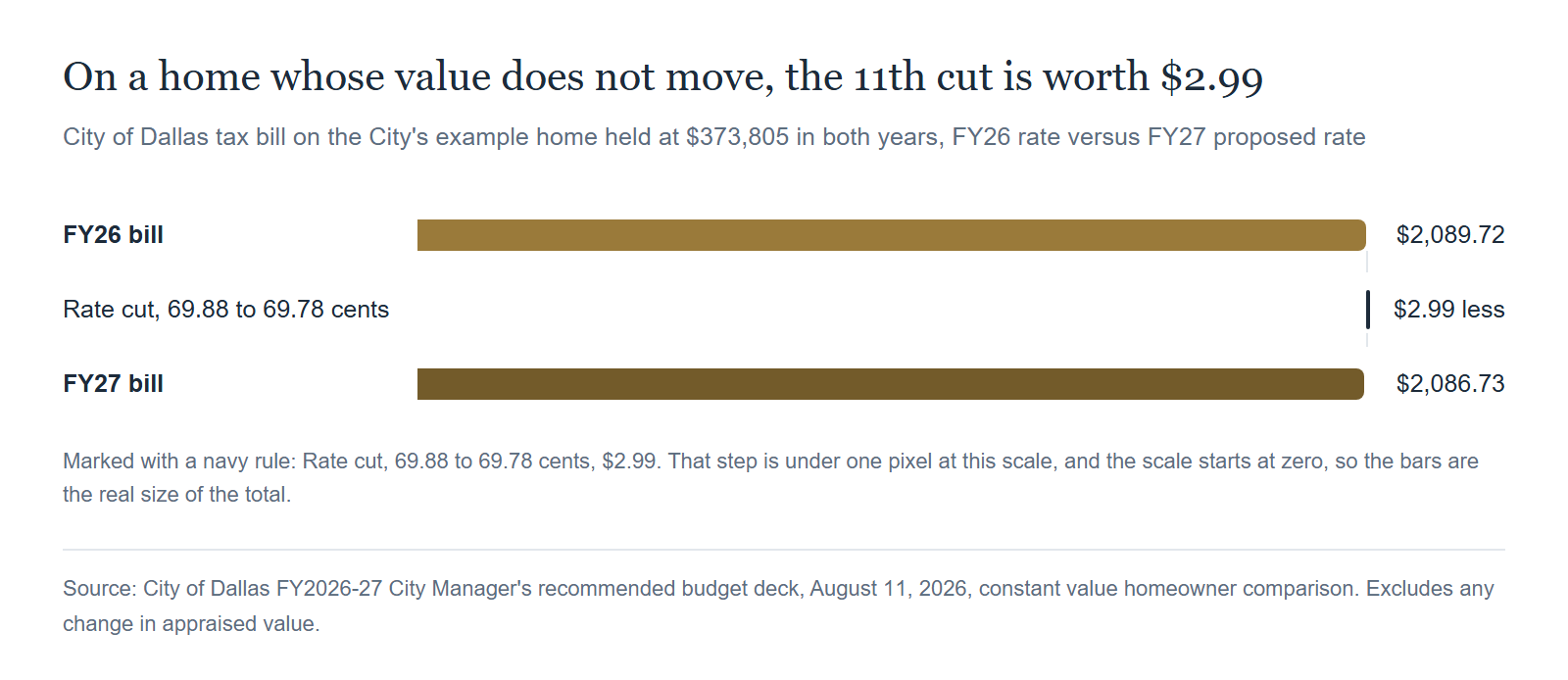
Keep the condition attached to that number. The $2.99 is not a forecast of anyone's bill. It is what the rate change by itself does to a home whose appraisal did not move.
Now the honest part, because it cuts against the headline. At the City's citywide median value, the bill actually went down this year. It fell $61.61.
That drop is real, and it is mostly not the rate. The median home the City measures lost value between the two years. Of the decline, roughly a twentieth came from the rate cut. The value did the rest.
Why Your Bill Can Rise While the Rate Falls
Three plain definitions first, because these words get used loosely.
Your appraisal is the appraisal district's estimate of what your home is worth. Your taxable value is what is left after your exemptions, subject to the cap below, and it is the number the tax rate is actually multiplied by. For city taxes, Dallas exempts 20 percent of a homestead's value before the rate touches it.
The 10 percent cap is a Texas law that limits how fast the taxable value of a homestead can climb. The limit is 10 percent of last year's appraised value, plus the value of any new improvements. It caps the taxable value, not the market value.
So the bill has two inputs, and the City controls one of them. That is the escalator. You can walk down a moving staircase and still finish higher, if it climbs faster than you descend.
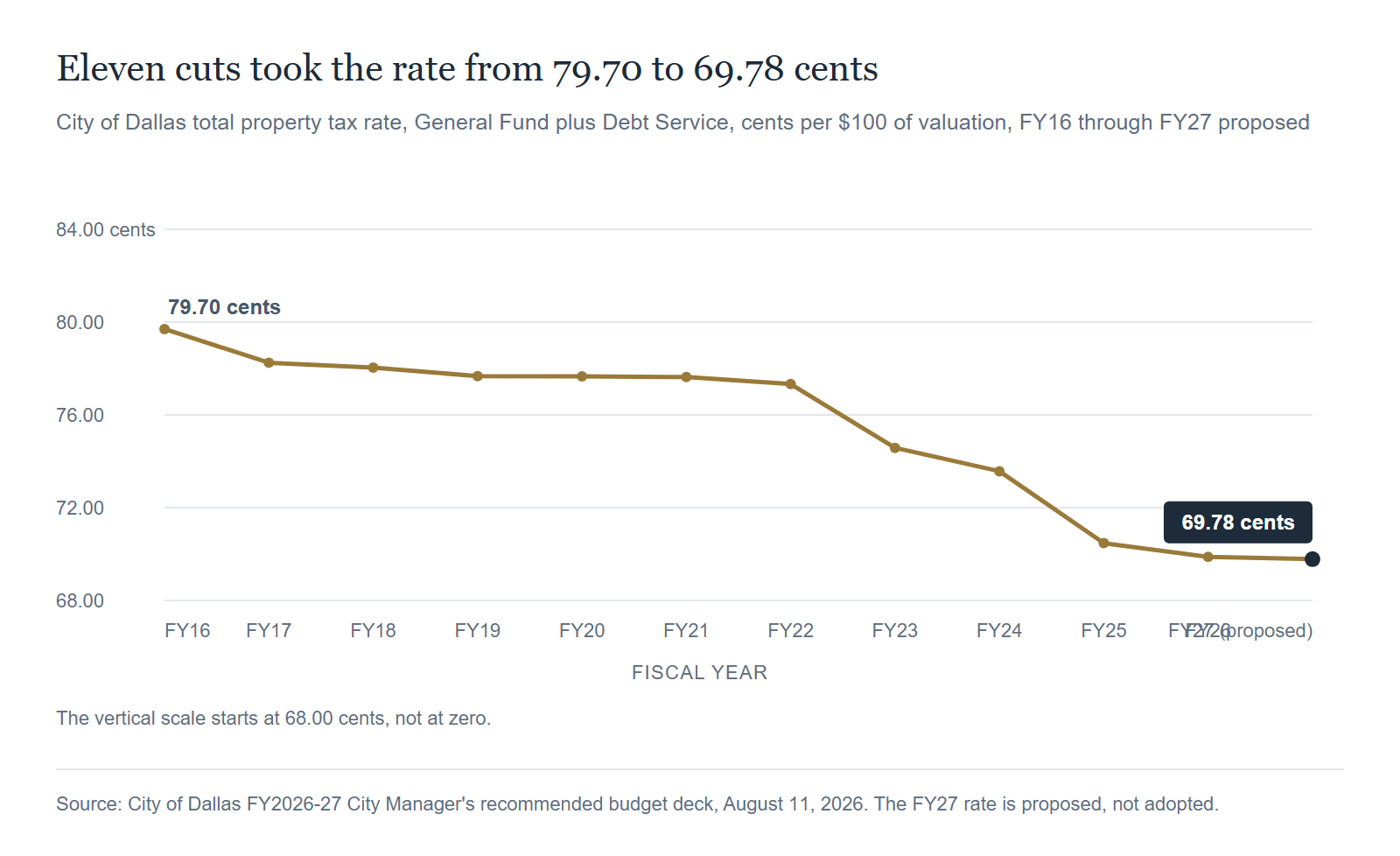
The streak itself is real. The rate has come down every year since fiscal year 2016, for a total reduction of 9.92 cents.
What the year by year view shows is that the cuts are uneven, and the recent ones are small. The largest was 3.10 cents. This year's is 0.10 cents, and the last three have shrunk each year.
Now put the escalator against it. It takes about $536 of appraised value increase on the City's example home to hand back the entire cut. Call that the tripwire.
The statutory cap sits at 10 percent. The tripwire sits at 0.14 percent. The protection homeowners have is not aimed at this problem.
A homestead can rise well inside its cap, in a year nobody would call a bad appraisal year, and still erase a full year of rate cutting many times over. That is not a useless cap. It guards a different problem.
Citywide, the value being taxed grew 4.97 percent this year. Two thirds of that came from reappraisal of property that was already standing, not from new construction.
Where Your City Tax Dollar Goes
On the City's illustrative 2025 blend, the City is not the biggest line on a Dallas tax bill. It is not close to half of it either.
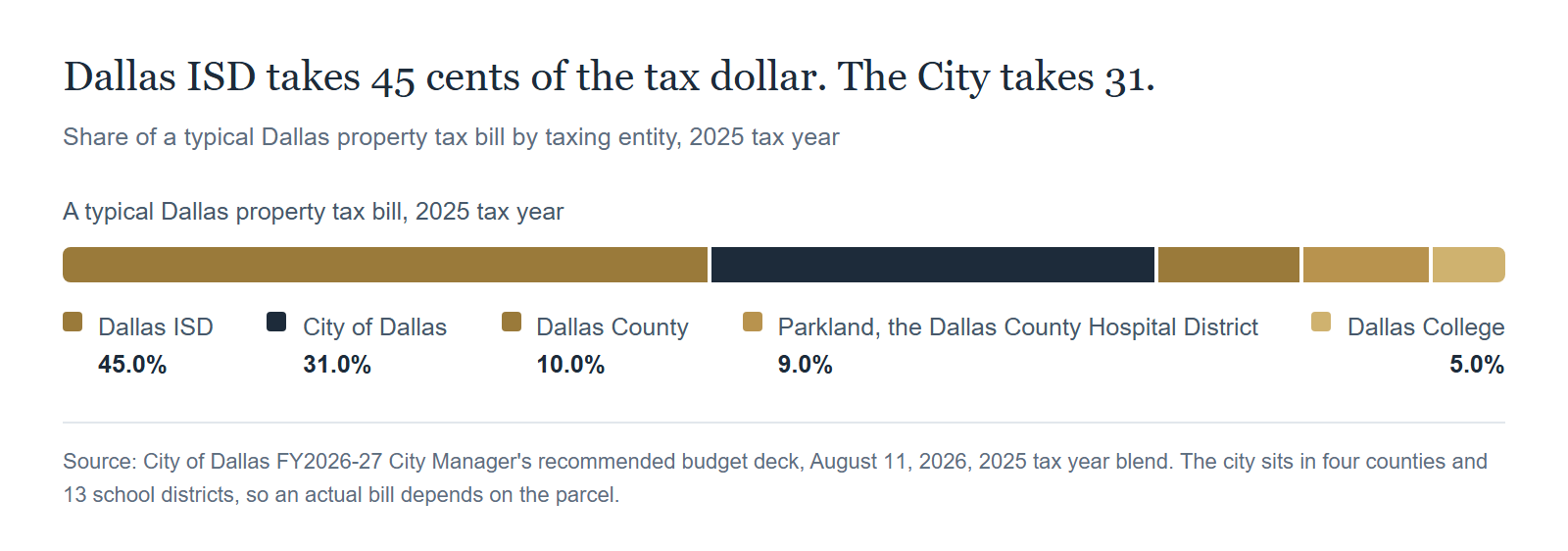
Apply the blend to the example home anyway. The full property tax bill works out to about $6,731 for the year, or roughly $561 a month inside an escrow payment.
Against that, this year's rate cut is $2.99. Most homeowners watch the escrow line, and a change this small is easy to miss on it.
The No-New-Revenue Gap
There is one published benchmark that separates a rate cut from a tax cut. The no-new-revenue rate is the rate that would raise the same total as last year on property taxed in both years. If the adopted rate lands above it, collections rise.
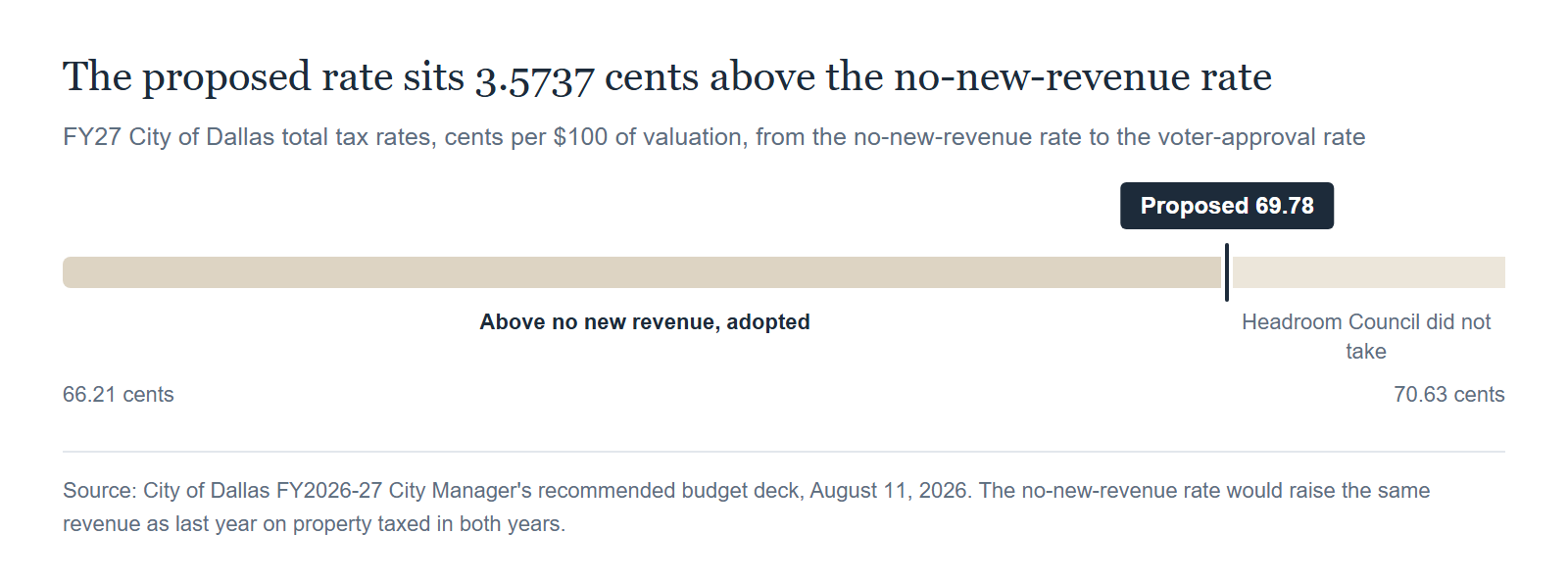
The proposed rate lands above it, by about 3.57 cents.
The City scores the same question in dollars, on a narrower basis. Adopting the no-new-revenue rate instead would collect $82.7 million less than the proposed budget. The two figures are not interchangeable, and the last section says why.
The proposal also declines to take everything available. The voter-approval rate is the most the Council can adopt without an election, and the City Manager's proposal sits below it. A budget written to maximize revenue had a legal path to more and did not take it.
What You Can Do
Two things are still open, and neither one of them is the rate.
The first is the calendar. First reading of the budget is September 2, 2026. Final adoption of the tax rate and the budget is September 16, 2026, and the fiscal year begins October 1. The public budget hearing was held August 25. If you want to be heard on the rate itself, that is the whole window.
The second is your appraisal, and it is the lever with actual leverage. Texas Tax Code Section 41.44 sets the protest deadline at May 15, or the 30th day after your notice was delivered, whichever is later. The protest is against the value, not the rate.
One protest can reach more than the city line. The taxing entities generally work from the same appraised value, so a successful protest usually lowers the other portions as well, subject to each entity's own exemptions. Our 2026 Protest Playbook, linked below, walks through the filing.
Then be clear with yourself about what the cap does. It slows how fast your taxable value can climb. It is not a ceiling on your bill, and it does nothing about the small movement that erases a year of rate cutting.
The Paragon Angle
In our transactions, the tax figure a seller quotes comes off their own last notice. It is not the number the buyer inherits. That is why the rate ordinance is the least useful document in the conversation.
In our experience, a lender sizes the escrow estimate off the rate applied to the appraised value, not off what the current owner happens to pay. A buyer who qualified in April against last year's number can watch that estimate move in the middle of the option period. And most of what that buyer pays is set by entities that were never in the headline.
Sellers own the other half of this. A tax figure carried forward from a prior year's notice is not a disclosure of what the home costs to carry. Better to have that conversation in week one than as an escrow shortage in year two.
Then there is the part that reaches people who are not selling anything. As our over-ask fact check found, linked in Related Articles, the price reported on a sale is the gross one, and it includes any premium the seller handed straight back in concessions at closing. A sale that only cleared asking because the seller funded the buyer's costs still enters the record at the higher number. In our experience, that recorded number is what a neighbor's comparable sales evidence gets read from.
Our read: a neighbor who never listed and never negotiated anything can pick up a higher appraisal off a premium nobody kept.
The Math, If You Want It
Everything above is derived here, with the arithmetic shown. Skip it if you already have what you came for.
The rate, year by year
The City's published rate history, General Fund and Debt Service combined, back to fiscal year 2016.
Fiscal Year | Total Rate (cents per $100) | Change from Prior Year |
|---|---|---|
FY16 | 79.70 | (baseline) |
FY17 | 78.25 | -1.45 |
FY18 | 78.04 | -0.21 |
FY19 | 77.67 | -0.37 |
FY20 | 77.66 | -0.01 |
FY21 | 77.63 | -0.03 |
FY22 | 77.33 | -0.30 |
FY23 | 74.58 | -2.75 |
FY24 | 73.57 | -1.01 |
FY25 | 70.47 | -3.10 |
FY26 | 69.88 | -0.59 |
FY27 (proposed) | 69.78 | -0.10 |
Cumulatively that is 9.92 cents of reduction. The deck labels it two ways: 10.8 percent on the trend chart and 12.4 percent on the slide computing the revenue effect. We use 12.4 percent, the slide that also produces the $229.7 million forgone against a $237.7 billion value base.
The $2.99, recomputed
The City's constant value comparison, and our line by line check of it:
FY26 rate applied | FY27 rate applied | |
|---|---|---|
Home value (held constant both years) | $373,805 | $373,805 |
Tax rate | 69.88 cents per $100 | 69.78 cents per $100 |
City tax bill | $2,089.72 | $2,086.73 |
Change | -$2.99 |
1. Taxable value after the City's 20 percent homestead exemption: $373,805 multiplied by 0.80 equals $299,044.00.
2. FY26 bill: $299,044.00 divided by 100, multiplied by $0.6988, equals $2,089.72.
3. FY27 bill: $299,044.00 divided by 100, multiplied by $0.6978, equals $2,086.73.
4. Difference from the rate cut alone: $2,086.73 minus $2,089.72 equals negative $2.99.
What erases it
Paragon's math, not the City's. Solve the same formula backward at the FY27 rate:
1. Taxable value increase required to add $2.99 of city tax: $2.99 divided by 0.006978 equals $428.49.
2. Appraised value increase required, since taxable value is 80 percent of appraised value after the exemption: $428.49 divided by 0.80 equals $535.61.
3. As a share of the $373,805 example value: $535.61 divided by $373,805 equals 0.143 percent.
The Section 23.23 cap is 10 percent. Ten divided by 0.14 is 71.4, so the cap is roughly 71 times too blunt to catch the movement that matters here.
Why the median bill fell $61.61
The City's other comparison uses the actual median value in each year. The median value fell from $384,290 to $373,805, the rate fell from 69.88 to 69.78 cents, and the bill fell from $2,148.33 to $2,086.73. The City's table prints the change as -$61.61; subtracting the two printed bills gives $61.60, a penny of rounding from the City's unrounded inputs.
Split that decline into its two causes. The value drop taken at the old rate is $10,485 multiplied by 0.80 multiplied by 0.006988, which is $58.62. The rate cut applied to the new value is the $2.99 above. Add the $2.99 and the two parts come to $61.61, the change the City prints. The rate cut is about 4.9 percent of the decline. The rate did move the bill, just not most of it.
The three rates side by side
Rate | Cents per $100 valuation |
|---|---|
No-new-revenue rate | 66.2063 |
Proposed FY27 rate | 69.78 |
Voter-approval rate (maximum without an election) | 70.6325 |
The proposed rate sits 3.5737 cents above the no-new-revenue rate. The $82.7 million figure is computed on a different basis: the General Fund operations portion of the rate, at a 97.39 percent collection rate. The 3.5737 cents is a total rate minus a total no-new-revenue rate. The voter-approval headroom the proposal leaves unused is 0.8525 cents, which the deck scores at $19.7 million uncollected.
Where the dollar goes, as a table
Taxing Entity | Share of a Typical Dallas Tax Bill |
|---|---|
Dallas ISD | 45% |
City of Dallas | 31% |
Dallas County | 10% |
Parkland (Dallas County Hospital District) | 9% |
Dallas College | 5% |
Applied to the example home: $2,086.73 divided by 0.31 equals $6,731.39 for the implied full year bill, which is $560.95 a month and rounds to $561. This year's rate cut against that implied bill is $2.99 divided by $6,731.39, or 0.044 percent. All of it carries the deck's own caveat about counties and school districts.
What the cut costs the City
The 0.10-cent reduction costs $2.3 million at a 97.39 percent collection rate. Against the $5.66 billion budget restated as $5,660 million, that is 0.041 percent. Against the $82.7 million no-new-revenue gap, it is 2.78 percent.
Value growth, decomposed
Total certified property value for FY27 is $237.7 billion, up $11.3 billion or 4.97 percent over FY26. New construction accounts for $3.9 billion, or 1.7 percentage points of that growth. Reappraisal of existing property accounts for $7.3 billion, or 3.24 percentage points. The no-new-revenue rate is defined on property taxed in both years, so the new construction slice is not what it measures against.
That 3.24 points is more than 20 times the 0.14 percent tripwire. It is a citywide figure set against a threshold computed on one example home, not a like for like pair, and the deck publishes no residential-only reappraisal rate. Roughly 96 percent of the city's value sits in Dallas County, which the deck shows growing 5.30 percent, from $216.1 billion to $227.6 billion as printed.
The reported service cuts
Reported reduction | Figure | Source |
|---|---|---|
Positions eliminated | 296, about 108 filled | Dallas Express, August 9, 2026 |
Library positions | 72, about 30 filled | CandysDirt, August 10, 2026 |
Park and Recreation positions | 30 | CandysDirt, August 10, 2026 |
Office of Arts and Culture positions | 12 | CandysDirt, August 10, 2026 |
Vehicles cut from the city fleet | 164 | CandysDirt, August 10, 2026 |
IT budget cut | $8 million | CandysDirt, August 10, 2026 |
Library spending cut | $3.3 million | CandysDirt, August 10, 2026 |
The figure 296 does not appear in the primary deck. The deck's own position tables show net rather than gross reductions: General Fund positions fall from 11,492 to 11,364, and combined Operating Funds positions from 15,589 to 15,469. The net numbers are smaller because the same budget assumes an increase of 400 police officers. A budget can cut positions in libraries, parks and arts while adding them in policing, and end up with a small net change that conceals a large reallocation.
Frequently Asked Questions
Did my Dallas property tax bill go up in 2026?
Not necessarily, and not at the City's own median. At the citywide median the bill would fall $61.61 under the proposal, mostly because that median value fell from $384,290 to $373,805. Your bill depends on your own appraised value, and the City is only about 31 percent of a typical total bill.
What is the no-new-revenue tax rate and why does it matter?
It is the rate that would raise the same revenue this fiscal year as last, on property taxed in both years. For Dallas in FY27 that rate is 66.2063 cents per $100. It separates a rate cut from a tax cut, because a rate can fall while collections rise. The proposed 69.78 cents sits 3.5737 cents above it.
How much did Dallas property tax revenue change this year?
The figure reproducible from the City's own tables is General Fund only: $1,176,557,369 for FY27 proposed against $1,123,874,550 for FY26 forecast, an increase of $52,682,819, or 4.69 percent. A larger figure of $65.5 million and 4.73 percent circulates in coverage, attributed to Council Member Cara Mendelsohn via CandysDirt on August 10, 2026. It could not be reproduced from the deck.
When can I protest my property appraisal in Texas?
Texas Tax Code Section 41.44 sets the deadline at May 15, or the 30th day after the appraisal district delivered your notice, whichever is later. The protest is against the value, not the rate, which is the input a homeowner can actually contest.
Does the new $140,000 Texas homestead exemption lower my Dallas city tax bill?
No. That increase came from Senate Bill 4 and Senate Joint Resolution 2, approved by voters as Proposition 13 on November 4, 2025. It applies to school district maintenance and operations taxes, the roughly 45 percent slice of that blend, not the City's 31 percent slice. What reaches the city portion are the City's own exemptions: 20 percent of value, plus a flat $175,000 for owners 65 and over or disabled.
When does Dallas City Council vote on the final FY27 tax rate?
First reading is September 2, 2026. Final reading, adopting the tax rate and the budget, is September 16, 2026. The fiscal year begins October 1.
Conclusion: The Rate Is the Headline. The Appraisal Is the Bill.
An 11th consecutive rate cut, once adopted, is a true statement. Nothing here argues the streak is fake. It is an argument about proportion.
This year's installment is one tenth of one cent. It costs the City less than the reported library cut in the same budget, and it comes entirely out of the debt payment. On the City's example home, held flat, it is worth $2.99 for the year against an implied total tax bill of roughly $6,700.
Meanwhile the other input moved 4.97 percent citywide, two thirds of it from reappraising property that already existed. It takes very little appraisal movement to cancel a whole year of rate cutting, and the cap meant to protect homeowners sits far above it.
The vote is September 16, 2026. Watch it if you like. Then watch for the appraisal notice. That is where the other input arrives, and it moves in percentages while the rate moves in hundredths of a cent.
Talk to Paragon
We spend a lot of time with clients on the carrying costs that never make it into the headline price. If you want a straight read on what a property will actually cost to own, we are glad to walk through it.
Email: [email protected]
Phone: (469) 290-7593
Online: paragondfw.com/contact
Related Articles
- We Fact-Checked Every Over-Asking Sale in DFW. Concessions Knock Nearly 4 in 10 Back to Asking or Below.
- Frisco Is Ranked the Number 1 Housing Market in America. Our Sold Data Tells a Different Story.
- Grapevine: The Small Town DFW Grew Around and Never Flattened
- Dallas Traffic Keeps Getting Worse. Your Property Tax Bill Knows Why.
- How to Protest Your Property Taxes in Texas: The 2026 Playbook
- We Mapped 301,062 DFW Home Sales. Go Find Your Neighborhood.
Sources
- City of Dallas, Office of the City Manager, "Budget Workshop: City Manager's Recommended Biennial Budget for FY 2026-27 and FY 2027-28," August 11, 2026. All city figures: https://dallascityhall.com/government/citymanager/Documents/Council%20Materials/A.%20City%20Manager's%20Recommended%20Biennial%20Budget%20for%20FY%202026-27%20and%20FY%202027-28.pdf
- CandysDirt, "Dallas Tightens Its Belt But Proposed Budget Still Hits a Record $5.6 Billion," August 10, 2026. Department reductions and the Mendelsohn figure: https://candysdirt.com/2026/08/10/dallas-tightens-its-belt-but-proposed-budget-still-hits-a-record-5-6-billion/
- Dallas Express, "Dallas City Manager Proposed $5.6 Billion FY 2026-27 Budget," August 9, 2026: https://dallasexpress.com/city/dallas-city-manager-proposed-5-6-billion-fy-2026-27-budget-eliminates-296-positions-no-tax-rate-hike/
- Texas Tax Code Section 41.44, protest deadline: https://codes.findlaw.com/tx/tax-code/tax-sect-41-44/
- Texas Tax Code Section 23.23, the 10 percent cap on homestead taxable value growth: https://codes.findlaw.com/tx/tax-code/tax-sect-23-23/
- Office of the Lieutenant Governor of Texas on Senate Bill 4 and Senate Joint Resolution 2, February 13, 2025: https://www.ltgov.texas.gov/2025/02/13/lt-gov-dan-patrick-statement-on-the-unanimous-passage-of-senate-bill-4-and-senate-joint-resolution-2-increasing-the-homestead-exemption-to-140000-and-150000-for-seniors/
- Dallas Central Appraisal District, "Average and Median Residence Homestead Values," https://www.dallascad.org/avghouseval.aspx
- Paragon Realty Advisors, "How to Protest Your Property Taxes in Texas: The 2026 Playbook": https://www.paragondfw.com/blog/how-to-protest-your-property-taxes-in-texas-the-2026-playbook
- Paragon derived arithmetic, shown line by line in The Math above and computed from the City figures cited here: the $428.49 and $535.61 breakevens, the 0.143 percent threshold, the 71.4 cap ratio, the $6,731.39 implied bill, the $560.95 monthly figure, the 0.8525 cent headroom, the $58.62 value share of the median decline.