Key Takeaways
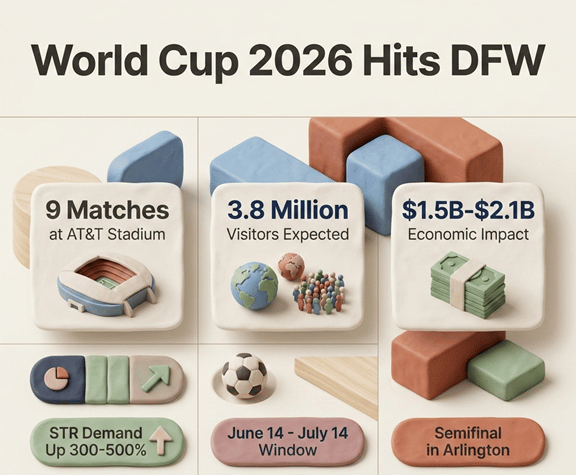
- AT&T Stadium will host 9 FIFA World Cup matches between June 14 and July 14, 2026, including a semifinal. That is more matches than any other venue across all 16 host cities in three countries.
- DFW is expected to welcome 3.8 million visitors during the tournament, with short-term rental demand already up 300-500% year-over-year for June dates.
- The projected economic impact ranges from $1.5 billion to $2.1 billion, but independent economists consistently find official mega-event projections are overstated by 30-50%.
- Homeowners in the DFW metro should understand both the opportunity (short-term rental income, long-term appreciation from global exposure) and the risks (regulatory uncertainty around STRs, renter displacement, and the gap between hype and reality).
- The lasting impact will not be measured in a single summer's tourism dollars. It will be measured in whether DFW converts global visibility into sustained corporate investment and population growth.
The Biggest Sporting Event in History Is Coming to Your Backyard
In roughly 100 days, DFW will become the operational epicenter of the largest single sporting event ever staged. The 2026 FIFA World Cup, the first to feature 48 teams playing 104 matches across 16 cities in three countries, will run from June 11 through July 19. And no city in America has more at stake than Dallas-Fort Worth.
AT&T Stadium in Arlington, rebranded as "Dallas Stadium" for the tournament, will host 9 matches, more than any other venue. Five group stage games. Four knockout rounds, including a semifinal on July 14. The marquee draw: Argentina plays twice in Arlington during group play, virtually guaranteeing global television audiences in the hundreds of millions for DFW's venue alone.
But this is not just about what happens on the pitch. For homeowners, buyers, investors, and anyone who cares about the DFW real estate market, the World Cup represents both a generational opportunity and a landscape littered with hype that does not hold up under scrutiny. Here is what the data actually says.
One underreported risk: in past mega-events, short-term rental surges have displaced existing long-term tenants. Landlords converting units to Airbnb for tournament income can trigger lease non-renewals and rent spikes in surrounding neighborhoods. DFW renters in high-demand corridors near AT&T Stadium should review their lease protections now, and investors should weigh the reputational and regulatory risk of displacing tenants for a single summer’s revenue.
DFW as Command Center: More Than Just a Host City
Most people know DFW is hosting matches. What they do not know is that Dallas is running the entire tournament.
The International Broadcast Centre (IBC) and the Tournament Operations Center (TOC) are both located at the Kay Bailey Hutchison Convention Center in downtown Dallas. The city invested approximately $15 million in capital improvements to secure this designation. Every broadcast feed, every operational decision for all 104 matches across three countries flows through Dallas for 39 straight days.
This is not a weekend event. This is a month-long global media operation headquartered in DFW, with FIFA-approved training camps scattered across the region at Toyota Stadium in Frisco, TCU, UNT, Dallas Baptist University, and Mansfield Multipurpose Stadium. Teams and their entourages will be living, eating, and spending in North Texas for weeks, not days.
That distinction matters for real estate. A weekend Super Bowl generates a tourism spike. A 30-day operational headquarters generates sustained demand across hospitality, housing, and commercial real estate.
One infrastructure gap worth noting: Arlington is the largest U.S. city without public transit. There is no DART rail to AT&T Stadium, no bus rapid transit, and limited ride-share staging during high-volume events. For STR operators, this means location within walking distance or shuttle range of the stadium carries a significant premium, while properties even a few miles away may struggle to command event-level rates. For buyers evaluating long-term investment, this transit void also limits the district’s ceiling as a walkable urban destination—which is the very transformation Arlington is banking on.
The Short-Term Rental Gold Rush (and Its Fine Print)
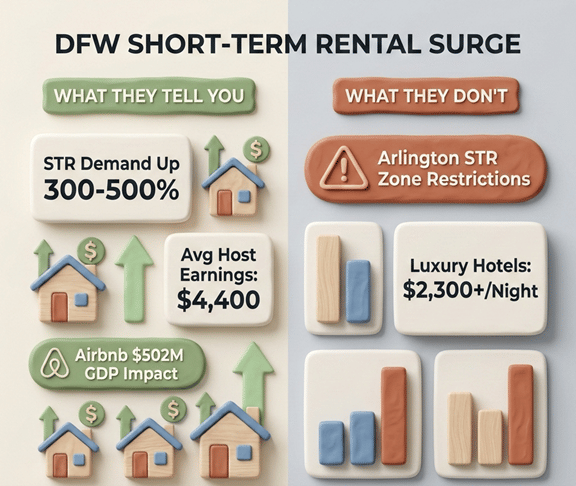
The numbers are staggering. Short-term rental demand for June dates in Dallas is up 300-500% year-over-year. Fort Worth is up even more, at 500-700%. When FIFA announced the group stage schedule on December 5, 2025, Dallas saw a 102% spike in STR bookings within days.
Deloitte projects the average DFW Airbnb host will earn $4,400 over the course of the tournament. Luxury hotel suites near AT&T Stadium are already listing at $2,300-$3,600 per night. Airbnb is so confident in demand that it is offering $750 cash bonuses to North Texas homeowners who list their property for the first time before the tournament begins.
On paper, this looks like free money. In practice, there are complications that most coverage is ignoring.
The Regulatory Minefield
Arlington has a designated short-term rental district. Outside that specific zone, STRs are banned. Most residential neighborhoods near AT&T Stadium are not in the approved district. If you own a home in Arlington and are planning to list it on Airbnb for the World Cup, you need to verify your zoning before you spend a dollar on preparation.
Dallas is in the middle of an active legal battle over its short-term rental ordinance, which bans Airbnb and VRBO rentals in single-family residential neighborhoods. The City of Dallas asked the Texas Supreme Court to lift a lower-court injunction so enforcement could begin before the World Cup. As of early 2026, the legal outcome remains unsettled.
This is not a theoretical risk. Operators in both cities face genuine regulatory uncertainty heading into the highest-demand window in DFW history. The opportunity is real. So is the possibility that your listing gets shut down or fined.
What Smart Operators Are Doing
The homeowners who will profit from this are the ones treating it like a business, not a windfall. That means:
Step 1: Confirming zoning and STR eligibility
Step 2: Pricing strategically, not gouging. Properties priced 2-3x normal rates will book. Properties priced 10x will sit empty while hotels absorb the demand.
Step 3: Booking minimum stays of 3-5 nights to filter for quality guests and reduce turnover
Step 4: Carrying proper insurance. Standard homeowner policies do not cover short-term rental activity. A single liability claim from a World Cup guest could cost more than the entire summer's revenue.
There is another factor most STR projections are ignoring: hotel supply. DFW has added over 5,000 new hotel rooms since 2022, with several properties timed specifically for World Cup demand. That new inventory competes directly with Airbnb operators on price and convenience. If hotel occupancy underperforms projections, expect aggressive rate cuts that pull STR demand downward. The operators who win will be those offering something hotels cannot: space, kitchens, group accommodations, and neighborhood character.
What Happens to Property Values? The Historical Playbook
Every World Cup host city hears the same promise: this event will drive property values up. The historical record is more nuanced than the headlines suggest.
The Bull Case
Brazil's 2014 World Cup saw host cities average 11% property value appreciation in the year leading up to the event. Sao Paulo gained 25%. Rio gained 28% between 2010 and 2013. Qatar's 2022 tournament produced a 13% surge in prime residential real estate during the preparation phase. Rental prices in host cities surged dramatically during the events — Airbnb rates more than doubled and traditional rents jumped over 40%.
The Bear Case
Germany's 2006 World Cup largely broke even on property impact. South Africa's 2010 and Brazil's 2014 tournaments posted net economic losses when full infrastructure costs were counted against actual returns. The property booms in Rio and Sao Paulo reversed sharply after the tournaments ended.
What This Means for DFW
Arlington's median home price sits at approximately $320,000 as of January 2026, up a modest 1.6% year-over-year. The broader DFW metro has been in a normalization phase, with inventory rising and price growth cooling. The World Cup is not going to single-handedly reverse that trajectory.
What it can do is accelerate a trend that was already underway. Arlington's Entertainment District, anchored by AT&T Stadium and Globe Life Field, has attracted over $1.5 billion in development in recent years: the $550 million Loews Arlington Hotel, the $70 million One Rangers Way luxury multifamily project, a new $410 million hotel under development, and the IndyCar Grand Prix street circuit that debuted in March 2026.
The World Cup adds global visibility to a district that was already transforming from a parking-lot corridor into a walkable, mixed-use destination. The zip code immediately surrounding the stadiums, 76011, is transitioning from surface parking and light industrial to residential and hospitality. If past mega-venue districts are any guide, early investment in this transition zone has historically outperformed surrounding areas over 5-10 year windows.
But that is a long-term thesis, not a three-month trade. Anyone buying property in Arlington specifically because of the World Cup should be underwriting a 5-year hold, not a summer flip.
And here is the part most World Cup investment theses leave out: Texas property taxes. If your Arlington purchase appreciates 10–15% over five years, your county appraisal will follow. At Tarrant County’s effective rate of roughly 2.2%, a $320,000 property appreciating to $370,000 adds approximately $1,100 per year in property taxes. Over a 5-year hold, that is $5,500 in additional carrying costs that directly erode your appreciation gains. Factor property tax escalation into every pro forma, or your returns will disappoint.
The $2 Billion Question: Is the Economic Impact Real?
The official projections are enormous. Visit Dallas estimates the World Cup will generate $1.5 billion to $2.1 billion in economic impact for the DFW region. Airbnb alone projects its guests will contribute $502 million in GDP. Nationally, FIFA claims the tournament will produce $17.2 billion in GDP and 185,000 jobs.
These numbers deserve scrutiny.
The Mega-Event Track Record
When Arlington hosted Super Bowl XLV in 2011, the North Texas Host Committee claimed $611.7 million in economic impact. Independent economists, including researchers from Washington University and the consulting firm SportsImpacts, pegged the real number between $200 million and $300 million. That is a 50-65% haircut from the official figure.
This is not an anomaly. Academic research on mega-events consistently finds that official economic impact studies are inflated by 30-50%. The reasons are structural:
Substitution effects: Local residents leave town during the event, offsetting visitor spending
Leakage: Tourist dollars flow to multinational hotel chains and airlines, not local businesses
Displacement: Normal business travel and conventions avoid the host city during the event
Crowding out: Restaurants and attractions that benefit are offset by those that lose regular customers who stay away
None of this means the World Cup will not generate real economic activity. It will. But the $2.1 billion headline should be treated as a ceiling, not a floor. The realistic range, adjusting for historical overstatement, is likely $800 million to $1.3 billion. Still enormous. Just not what the press releases say.
The Real Prize Is Not Tourism Dollars
The lasting economic value of hosting the World Cup has never been about the tourism revenue generated during the event itself. It is about brand positioning.
DFW has attracted over 100 corporate headquarters since 2018, including CBRE, Caterpillar, and Charles Schwab. The metro already ranks number one in the nation for real estate investment and development. A month of global broadcast exposure, with DFW positioned as the operational command center for the entire tournament, reinforces that brand to corporate decision-makers worldwide.
That is the math that matters for long-term property values. Not the Airbnb revenue from a single summer, but the sustained corporate migration that global visibility accelerates.
What Every DFW Homeowner Should Do Before June
Whether you plan to rent your property, buy near the action, or simply watch from your couch, there are practical steps to consider.
If You Own Property Near AT&T Stadium or in High-Demand Areas
Check your STR eligibility now. Arlington's STR district restrictions are specific and enforceable. Dallas's legal landscape is uncertain. Do not assume you can list.
Get proper insurance. Contact your carrier about short-term rental riders. Standard homeowner policies exclude commercial hosting activity.
Price rationally. The data supports 2-3x normal rates for well-positioned properties. Listings priced at 5-10x will lose to hotels and legitimate STR operators with review histories.
If You Are Considering Buying
Underwrite for 5 years, not 5 months. The World Cup is a catalyst, not a thesis. The Entertainment District transformation in Arlington has real momentum, but the returns are in long-term appreciation, not a summer pop.
Look at 76011 and adjacent zip codes. The transition zone around the stadiums is where the development pipeline is concentrated. Mixed-use zoning changes are the leading indicator.
Watch the STR regulations. If Dallas resolves its legal battle and permits residential STRs, the investment calculus for properties near major venues changes significantly.
If You Are Selling
Spring 2026 is your window. Listing before the tournament, when anticipation and media coverage are peaking, captures the maximum hype premium. Listing after, when the economic impact numbers are being debated, does not.
Stage for the international buyer. DFW is going to have unprecedented international visibility. If your property appeals to relocation buyers or international investors, lean into that in your marketing.
Frequently Asked Questions
How many World Cup matches will be played in DFW?
Nine matches at AT&T Stadium (renamed "Dallas Stadium" for the tournament) between June 14 and July 14, 2026. Five group stage games and four knockout rounds, including a semifinal.
Will the World Cup increase my home value?
Historical data from past World Cups shows host city appreciation ranging from flat (Germany 2006) to 11-13% (Brazil 2014, Qatar 2022). DFW's impact will depend more on the long-term corporate relocation pipeline than on the tournament itself. The World Cup amplifies existing momentum rather than creating it from scratch.
Can I rent my home on Airbnb during the World Cup?
It depends on where you live. Arlington restricts STRs to a designated district. Dallas is litigating its STR ban. Verify your zoning and legal eligibility before listing. Violations carry fines, and enforcement is expected to increase around the tournament.
What is the expected economic impact?
Official estimates range from $1.5 billion to $2.1 billion. Adjusted for the historical overstatement typical of mega-event projections, the realistic impact is likely $800 million to $1.3 billion, which is still transformative for the region.
When do DFW matches start and end?
The first DFW match is June 14, 2026 (Netherlands vs. Japan). The last is the semifinal on July 14, 2026. The overall tournament runs June 11 through July 19.
The Bottom Line: Think in Decades, Not Weekends
The 2026 World Cup is going to be an extraordinary event for DFW. Nine matches. A semifinal. Argentina in Arlington. The global broadcast headquarters running through downtown Dallas for 39 days. 3.8 million visitors. There is nothing comparable in this region's history.
But the homeowners and investors who benefit most will be the ones who see past the summer spectacle. The short-term rental opportunity is real but comes with regulatory landmines. The economic impact will be significant but not as large as the headlines claim. The property value impact will be modest in the short term but potentially meaningful over a 5-10 year horizon, especially in the Entertainment District transition zone.
DFW was already the top real estate market in America before FIFA chose Arlington. The World Cup does not change the fundamentals. It amplifies them. And for a metro that has been quietly outperforming every major city in Texas for corporate relocation, infrastructure investment, and population growth, that amplification is the real story.
The world is about to watch. Make sure your real estate position is ready.
Ready to discuss how the World Cup impacts your specific property or investment strategy?
Let's connect and talk through your goals.
(469) 290-7593 | paragondfw.com/contact
Related Articles
Understanding Closing Costs in Texas: A Comprehensive Guide for Buyers and Sellers — paragondfw.com/blog/understanding-closing-costs-in-texas
The Buyer's Blueprint: A Strategic Guide to Dallas Real Estate — paragondfw.com/blog/the-buyers-blueprint-a-strategic-guide-to-dallas-real-estate
The Strategic Seller's Playbook: A 6-Phase Guide to Maximizing Your Texas Home Sale — paragondfw.com/blog/the-strategic-sellers-playbook
New Construction vs. Resale in DFW: A Buyer's Decision Framework for 2026 — paragondfw.com/blog/new-construction-vs-resale-in-dfw