Victory Park After the Teams Leave: What the Arena District Left Behind Actually Tells You
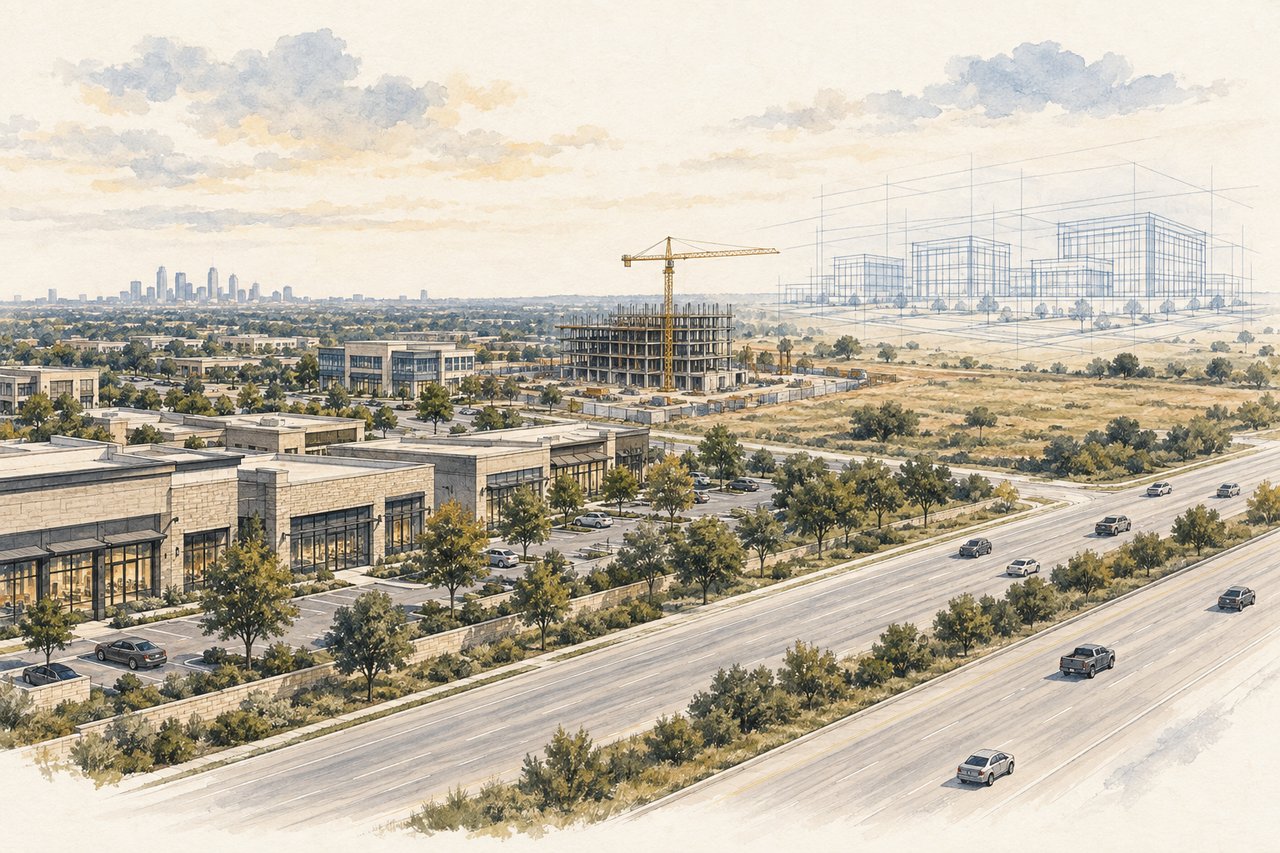
The headlines have been running wall to wall about the shiny new arena districts. The Mavericks are heading to the former Valley View Mall site in North Dallas. The Stars are planting a flag at the Shops at Willow Bend in Plano. Billions of dollars, new neighborhoods, civic pride, the whole show.
But there is a building nobody is talking about.
The American Airlines Center, owned by the City of Dallas, opened in 2001 and sits at the heart of Victory Park, a 75-acre urban district just north of downtown. Both anchor tenants have leases through 2031. Then both are gone. As of now, there is no announced plan for what happens to the building or to the district after they leave.
That is the story worth telling.
Key Takeaways
The American Airlines Center is city-owned, and Dallas has no public plan for the building after 2031 when both the Mavericks and Stars depart.
Victory Park already has roughly 4,000 residential units, DART light rail access, the Katy Trail, and one of the highest walk scores in Dallas. These assets do not leave with the teams.
Research on markets where teams have left shows nearby home prices sometimes rise, because game-day traffic, noise, and crowds were functioning as a disamenity for adjacent owners.
Hines is still building a new 28-story, approximately 497-unit residential tower at 2371 Victory Avenue, expected to complete in 2026. Developers are not fleeing.
The real risk is not the residential stock. It is the retail and restaurant tenants whose entire business model is built around 80-plus event nights per year.
For buyers and owners in Victory Park, the playbook is: watch the city's plan for the AAC site, track whether event-dependent retail thins out, and treat the transit and walkability fundamentals as the durable value floor.
What Everyone Gets Wrong About an Arena District Losing Its Anchor
The conventional take is simple: the teams leave, the district suffers, property values follow them north and east. If you believe that framing, you are probably more focused on the Frisco or Plano plays than anything inside the loop.
But the conventional take skips something important. Research on markets where professional sports teams have departed shows a more complicated picture. When a team leaves, it takes the event-night foot traffic with it. It also takes the game-day noise, the parking nightmare that swallows surface lots for blocks in every direction, the traffic that turns a Tuesday into a Friday, and the crowds that make a quiet dinner in the neighborhood a logistical problem.
For a condo owner in a high-rise 300 feet from an arena, those are not amenities. They are a tax.
Urban economists call this the donut effect. Properties immediately adjacent to an arena absorb the negatives during the team's tenure. A ring of properties just beyond that radius gets some economic benefit from nearby activity but less of the disruption. When the team leaves, the inner ring can actually see friction removed, not added. The neighborhood does not become less attractive. In some documented cases, it becomes more livable.
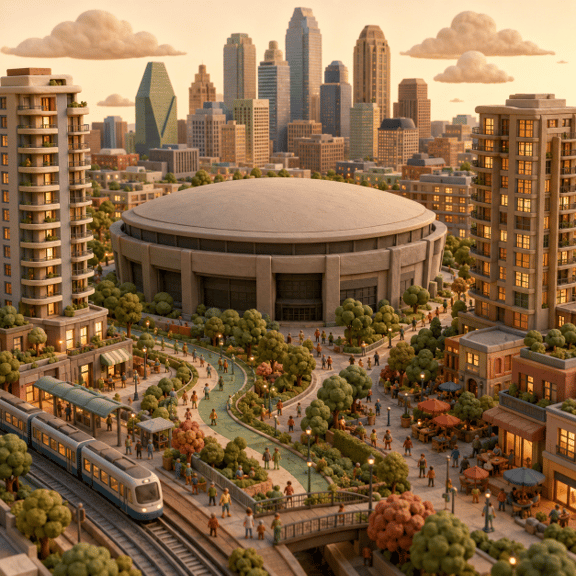
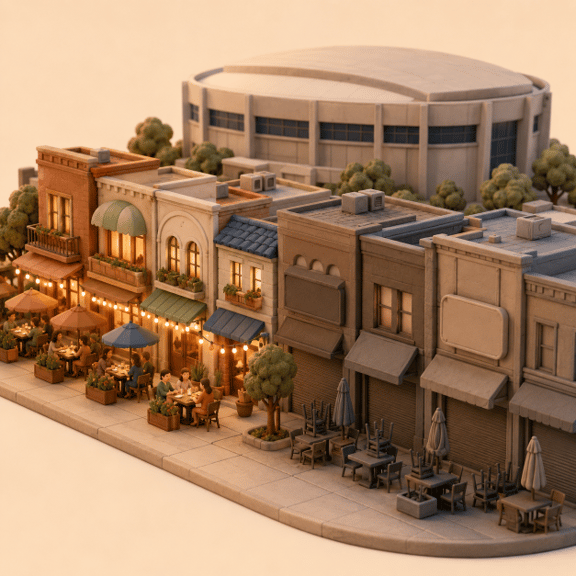
Victory Park is not a tailgate parking lot. It is a dense, walkable, transit-connected urban district. The residential towers there are not tailored to sports fans seeking proximity to the action. They are occupied by people who want to be close to downtown Dallas, the Katy Trail, the Perot Museum, and a DART station that gets them around the city without a car.
The District That Is Already More Than the Arena
Here is what Victory Park has that no suburban arena district can replicate in 2026 or 2031.
The DART Victory Station puts the district on the light rail network. You can get from Victory Park to other major Dallas nodes without driving. That is a structural differentiator in a metro that is otherwise almost entirely car-dependent.
The Katy Trail, one of the most-used urban trails in Texas, runs directly adjacent to the district. That is a genuine quality-of-life asset that has no relationship to who plays basketball or hockey in a nearby building.
Walkability to restaurants, the W Dallas Victory Hotel, House of Blues, and the Perot Museum of Nature and Science gives the district a reason to exist on a Tuesday with no game scheduled. Victory Park's walk score is among the highest in Dallas. That metric is not going to change when the Mavericks relocate to North Dallas.
The residential base is already substantial. Roughly 4,000 units are in the district, including The Victor, a 39-story Hines tower with 344 residences that stands as the tallest residential building in Victory Park, as well as The House, a 28-floor, 133-unit tower designed by Philippe Starck, along with the W Residences and Cirque. As of June 2026, the median home price in Victory Park is about $987,000, with an average sale price around $1.1 million. This is not a distressed market waiting for a catalyst.
And critically, Hines is building again right now. A new 28-story tower at 2371 Victory Avenue, with approximately 497 units, is expected to complete in 2026. Developers with institutional capital and long underwriting timelines are still betting on Victory Park. That is not the behavior of a group that thinks the district collapses when the teams go.
The Honest Counterargument: The Retail Risk Is Real
We are not here to tell you Victory Park is without risk. The contrarian read on residential value does not apply uniformly to every property type in the district.
Businesses that are built around event-night volume are in a genuinely uncertain position. A bar or restaurant that fills 80-plus nights per year because of Mavs and Stars games has a real revenue problem when those games move to North Dallas and Plano. The foot traffic those events generate does not have an obvious substitute. If event-dependent retail thins out, it changes the character of the district in ways that eventually affect residential demand too. Vacancy in street-level retail is not invisible to prospective buyers.
The Victory Park businesses that have publicly expressed nervousness about losing both anchor tenants are not wrong to be nervous. They are being honest about their exposure.
And then there is the building itself. A city-owned arena with no tenant is an expensive problem. No announced plan for the AAC after 2031 means Dallas taxpayers and city leadership will be negotiating a future for that structure under time pressure, with limited options. The building could be converted, demolished, repurposed as an entertainment venue for a different type of programming, or simply sit in limbo while the city figures it out. Each of those outcomes has a different impact on the surrounding district. Limbo is the worst of them.
The redevelopment uncertainty is real. It is one of the main reasons prices in Victory Park might wobble during the transition period, even if the long-term fundamentals are intact.
What to Watch If You Own or Are Buying in Victory Park
If you own a unit in Victory Park or you are considering buying there before 2031, here is the specific information you need to track.
The city's plan for the AAC site. This is the single most important variable. A clear redevelopment plan, with a credible use and a timeline, is the difference between managed transition and prolonged uncertainty. Watch Dallas city council communications and the Office of Economic Development for any announcements. The sooner a plan materializes, the lower the uncertainty discount on nearby property.
Whether event-dependent retail starts thinning. You do not need to wait until 2031 to see the first signal. Watch for lease non-renewals, restaurant closures, and changes in the street-level tenant mix over the next several years. Retail follows foot traffic forward, not backward. If the district's restaurant and entertainment operators start positioning for lower volume now, that tells you something about their read on the post-2031 environment.
DCAD assessments and protest strategy. Texas has no state income tax, so your property tax exposure in Victory Park is tied to what DCAD says your unit is worth. As the market processes the team departures, assessments may not adjust quickly. Homestead exemptions and formal DCAD protests are the tools available to Victory Park condo owners who think the assessed value no longer reflects market reality. This is worth reviewing annually through the transition period.
The Hines tower delivery. The new approximately 497-unit tower completing in 2026 adds meaningful supply to the district. Near-term, additional supply in a market with uncertainty creates pricing pressure. Medium-term, it signals that institutional investors are underwriting Victory Park as a durable location regardless of the arena tenants. Both readings are correct simultaneously, and the balance between them will show up in price-per-square-foot data over the next two to three years.
The Contrarian Opportunity
Markets price fear efficiently. If the consensus view between now and 2031 is that Victory Park is in decline, price per square foot in the district will reflect that fear before anyone has seen a single game played in North Dallas or Plano. That gap between fear-based pricing and fundamental value is where buyer opportunities tend to appear.
Victory Park's walkability, transit access, Katy Trail proximity, downtown adjacency, and established residential density are not going anywhere. These are the features that drive long-term urban residential value in every comparable U.S. market. They are also exactly what the new suburban arena sites lack and cannot build overnight.
The question for a serious buyer is not whether Victory Park is doomed. It is whether the market will price it as if it is doomed, and whether that creates a window to acquire at a discount to what the fundamentals actually support.
That is a window worth watching.
Frequently Asked Questions
Will Victory Park property values drop when the Mavericks and Stars leave?
Not automatically, and not necessarily. Research on markets where professional sports teams have left shows prices near arenas sometimes rise, because the teams were functioning as a disamenity for adjacent properties. Game-day traffic, noise, and parking disruption have real costs for nearby residents. Victory Park also has substantial fundamentals beyond the arena: DART rail, the Katy Trail, genuine walkability, approximately 4,000 residential units, and downtown adjacency. The real risk is event-dependent retail thinning out, not residential value collapsing. Prices may wobble during the transition on fear. Whether they recover depends heavily on what Dallas does with the AAC building.
Is now a bad time to buy in Victory Park given the uncertainty?
It depends on your timeline and your read on the AAC redevelopment. If Dallas announces a credible plan for the building, the uncertainty discount compresses quickly and early buyers benefit. If the site stays in limbo for years, pricing pressure persists. The case for buying now is that walkability, transit, and urban density are durable value drivers and that current pricing may already include a fear discount. The case for waiting is that more information about the city's plan will surface over the next year or two, and you can buy with better visibility. We would not frame this as a bad time to buy. We would frame it as a time to buy with your eyes open about the specific risks.
What happens to the American Airlines Center building after 2031?
There is no announced plan as of June 2026. The AAC is owned by the City of Dallas, which means the decision about its future is a public policy question as much as a real estate one. Possible outcomes include conversion to a different entertainment or event use, full redevelopment of the site, or extended uncertainty while the city assembles a strategy. The building's fate is the single largest variable in Victory Park's post-2031 outlook.
Should Victory Park condo owners be protesting their DCAD assessments?
Every Victory Park owner should be reviewing their DCAD assessed value annually. Texas property tax is one of the highest ongoing ownership costs in the state. If the market uncertainty around the team departures creates a gap between what DCAD says your unit is worth and what it would actually sell for, that is a legitimate and legally available basis for a formal protest. The homestead exemption applies if the unit is your primary residence. Both tools reduce your carrying cost during the transition period.
Talk to Paragon
We work across Dallas, and we spend a lot of time in close-in urban markets where the conventional wisdom and the actual data point in different directions. If you own in Victory Park, are thinking about buying there, or want a clear-eyed read on how the arena departures affect property values in adjacent neighborhoods, we are happy to walk through the numbers with you.
No hype. No agenda. Just the analysis.
Reach us at [email protected] or call (469) 290-7593.