Dallas Traffic Keeps Getting Worse. Your Property Tax Bill Knows Why.
Key Takeaways
Dallas drivers lost 44 hours to traffic in 2025, up from 41 the year before, costing the average driver about $810 in lost time (INRIX 2025 Global Traffic Scorecard).
The common explanation, that density causes both the traffic and the rising taxes, is backwards on both counts. The shared root cause is sprawl, the way the region has spread out.
Measured by the acre, dense development generates far more tax revenue and costs less to serve, while low-density development often does not cover the cost of its own roads and pipes over time.
Your individual tax bill still rises because Texas leans heavily on property taxes tied to your assessed value, and growth lifts the value of the land under your home.
For buyers and sellers, location and commute are underpriced. The practical moves are to protest your valuation on both available grounds and to weigh close-in value against the real tradeoffs of denser living.
Dallas drivers lost 44 hours to traffic in 2025, up from 41 the year before, according to the INRIX 2025 Global Traffic Scorecard. That is more than a full work week spent sitting still, and INRIX puts the cost at roughly $810 per driver in lost time. The national picture points the same direction, with the typical American driver losing 49 hours, six more than the year before. Traffic is not simply back to where it was. It is getting worse.
At the neighborhood meeting, the blame for all of it tends to land in the same place: density. Too many apartments, too many people, too many cars, and while we are at it, that is supposedly why the taxes keep climbing too. It is a satisfying story because it gives the frustration a single villain. It is also backwards on both counts. The traffic in your windshield and the increase on your appraisal notice trace back to the same root, and it is not the building going up down the street. It is the way Dallas has spread out.
This is not an argument that growth is bad or that your neighborhood should change. It is an argument that we are blaming the wrong thing, and that misreading the cause leads homeowners to fight the wrong fight while the real driver of their tax bill goes unaddressed.
It Is Not the Apartments. It Is the Sprawl.
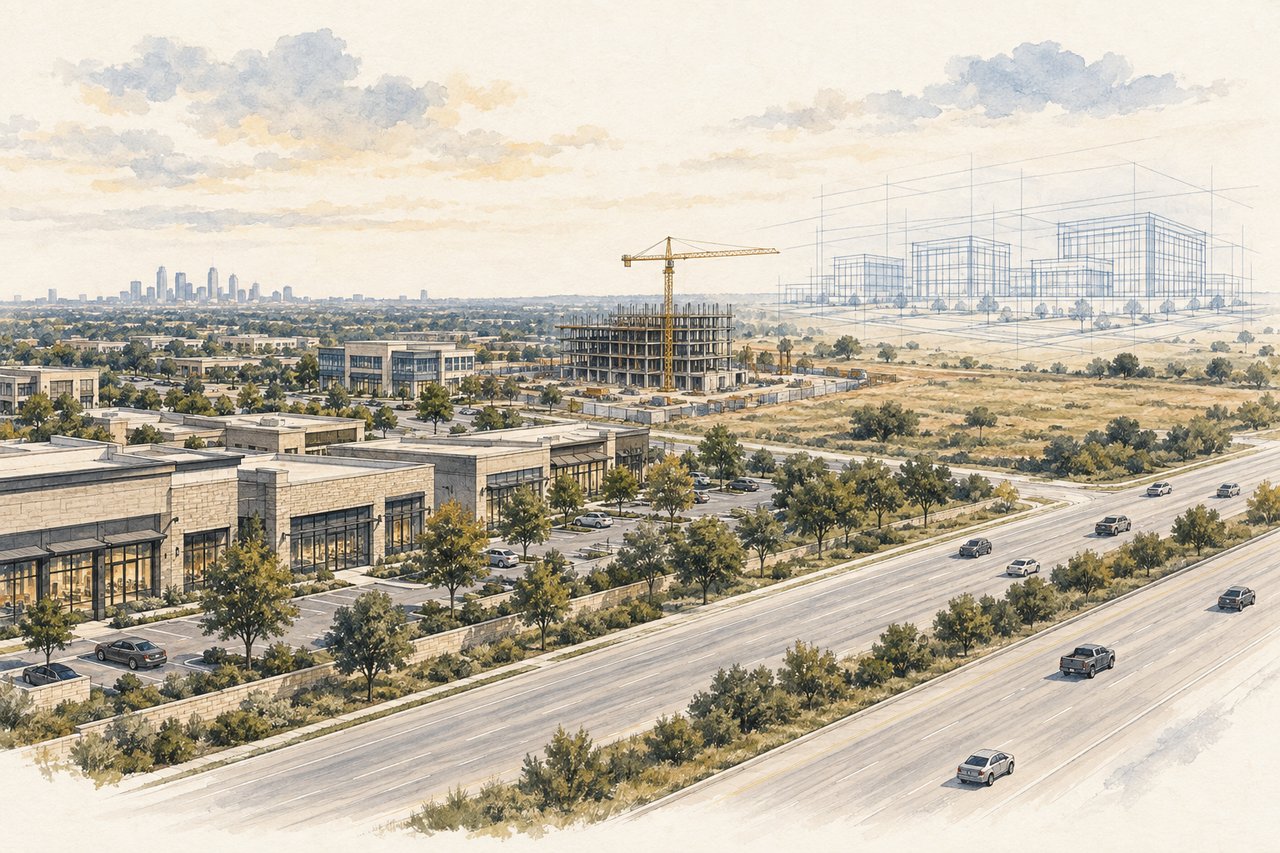
Start with the traffic, because it is the easiest to see. Congestion is mostly a function of distance, not just headcount. When the jobs sit in a few clusters and the rooftops spread thirty miles out in every direction, a huge number of people have to drive far, at the same time, on the same handful of highways. Outer-suburb growth feeding long commutes into a small number of job centers is the DFW pattern in one sentence.
Dense, close-in neighborhoods do the opposite. They put more people near where they work, shorten the average trip, and make transit, biking, and walking realistic instead of theoretical. A four-story building on a main street adds residents without adding much distance. A subdivision twenty-five miles out adds the same residents and guarantees that every one of their trips is long.
There is a fair counterpoint worth stating plainly. In the immediate blocks around a big new project, traffic and parking pressure can genuinely rise during and just after construction, and that lived experience is real. The point is not that density is invisible at the street level. It is that, region-wide, the math that fills I-35E, the Tollway, and 75 every morning is a distance problem, and distance is what sprawl manufactures. The traffic you sit in is largely a sprawl problem wearing a density costume.
And distance does not only cost you time on the highway. It also quietly breaks the math on what your city can afford to maintain, which is where your tax bill walks into the story.
The Per-Acre Math Nobody Shows You
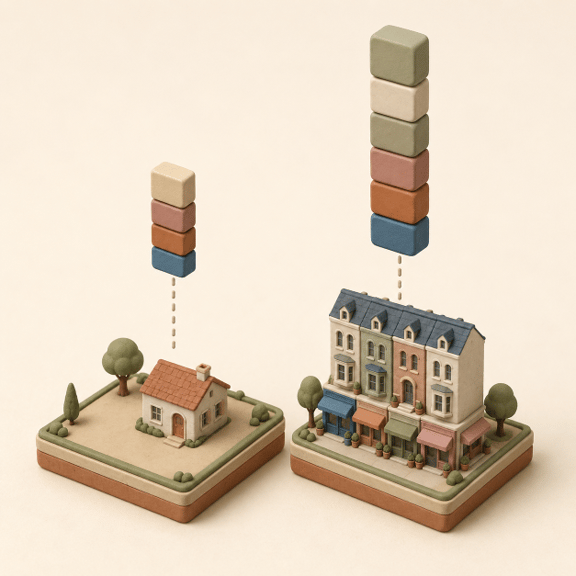
To see the connection, stop counting people and start counting acres. Spreading homes out means spreading roads, water lines, sewer pipes, drainage, and police and fire coverage out along with them. All of that infrastructure costs money to build once and, far more importantly, money to maintain and eventually replace forever after. The bill for a mile of road does not care whether four houses or forty front it.
Measured by the acre, then, dense development is the fiscal workhorse and spread-out development is the drain. Research compiled by Smart Growth America found that walkable, higher-density development generates on the order of ten times more tax revenue per acre than conventional suburban development, while costing local governments roughly 38 percent less to build infrastructure for up front and about 10 percent less to service each year. The studies behind those figures span multiple cities, and the direction of the finding is consistent even where the exact multiples vary.
Dallas has its own version of the same picture. Urban3, the firm that maps a city's property value by the acre, has shown that a typical single-family lot in Dallas County carries a taxable value of roughly $1 million per acre, while denser product such as duplexes and townhomes can run several times higher, up to around $22 million per acre at the top end. The same acre of dirt produces wildly different amounts of public revenue depending on what sits on it.
The uncomfortable conclusion, which urban economists have argued for years, is that a lot of low-density development does not generate enough tax revenue over its lifetime to pay for the roads, pipes, and services it requires. That shortfall does not vanish. It gets carried by the rest of the tax base, which, in a region built mostly at low density, means it gets carried by almost everyone. The denser, more productive parts of the city effectively subsidize the expensive, spread-out parts.
So Why Does Your Own Tax Bill Still Go Up?
Here is the twist that makes the whole thing feel upside down. If density pays for itself and sprawl does not, you would expect your taxes to drift down as Dallas slowly grows up instead of out. They do not. The reason is simple once you separate two ideas that usually get blurred together: efficient for the city is not the same as cheaper for you.
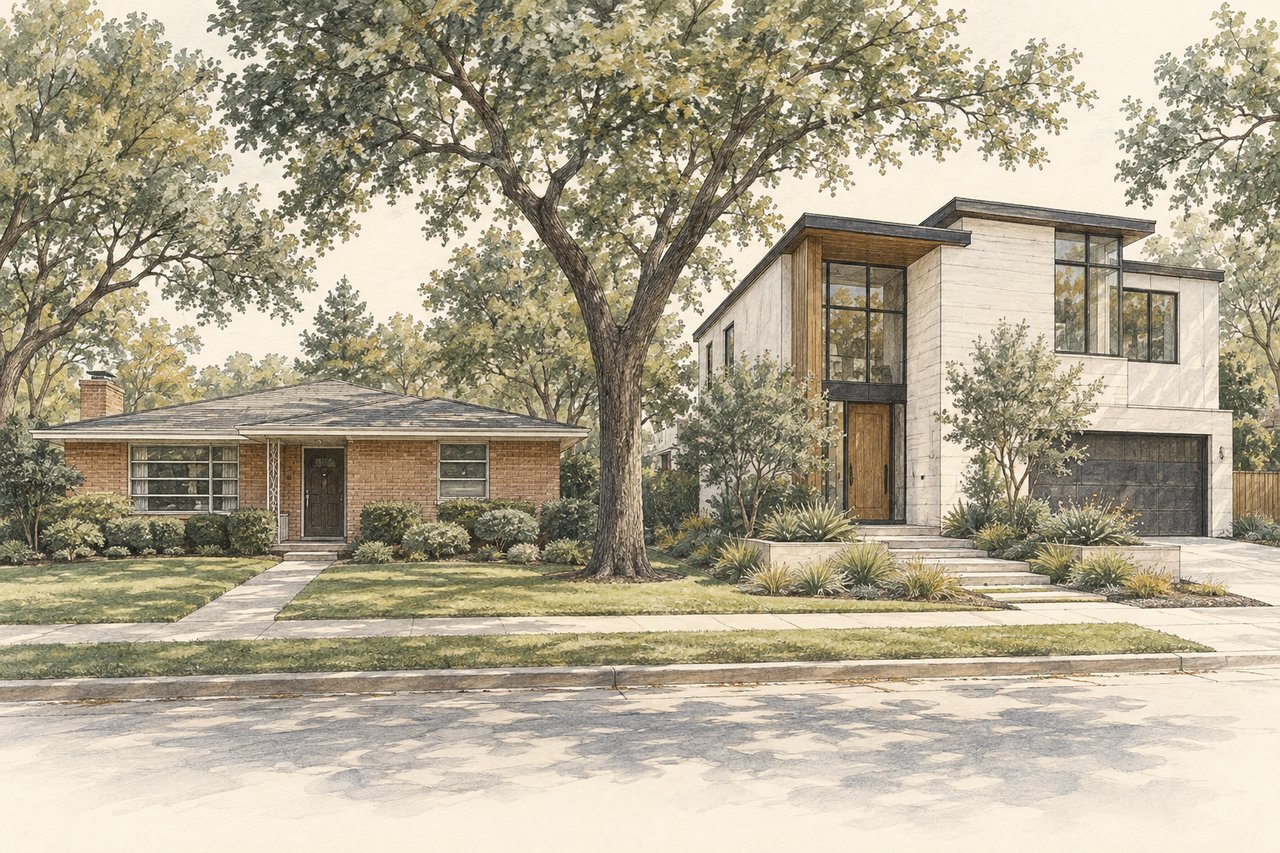
Texas has no state income tax. To fund schools, roads, and local government, the state leans harder on the property tax than almost anywhere else in the country, and your share of that is driven by your assessed value. When new development raises land values around you, the Dallas Central Appraisal District reassesses, and your taxable value climbs right along with the neighborhood. The more desirable and valuable your area becomes, the bigger the number on your notice. In fast-growing pockets, newer financing tools like Municipal Utility Districts and Public Improvement Districts can add their own charges on top of the base rate, which is why a brand-new master-planned community can carry a noticeably higher total tax rate than an established neighborhood a few miles away.
So both things are true at the same time. Density tends to make the city as a whole more solvent and your commute shorter, and it can still push your individual tax bill higher by lifting the value of the dirt under your house. The hours you lose in traffic and the jump on your appraisal are not two separate problems. They are the same bill for a spread-out region, arriving in two different envelopes.
It is worth being precise here, because it is easy to overclaim. Living in a dense neighborhood does not automatically lower your personal property taxes. In a desirable close-in area it can mean the opposite, because that land is exactly what the market is bidding up. The honest claim is narrower and more useful: sprawl is what makes the regional math expensive, and your own bill is set by valuation, not by the apartment building you can see from your porch.
What This Means If You Are Buying or Selling in DFW
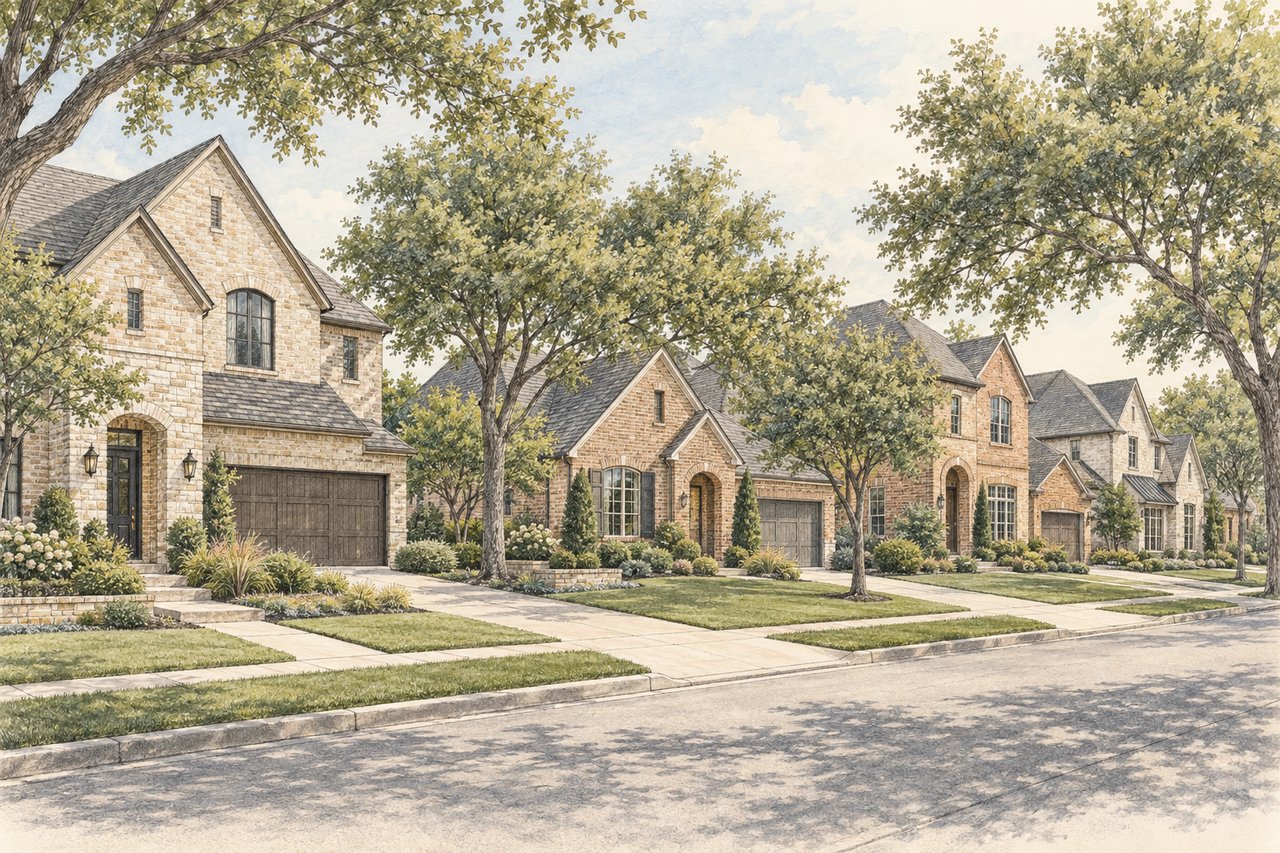
For anyone making a move in this market, the practical takeaway is that location and commute are underpriced relative to how much they actually matter. A close-in home with a fifteen-minute drive to work is, in real terms, buying back the 44 hours a year that far-flung neighbors are losing on the highway, plus the fuel and the wear that come with them. Homes in walkable, well-connected pockets tend to carry a value floor that distant subdivisions do not, because the thing that makes them valuable, proximity, cannot be built more of.
That does not make close-in the right answer for everyone, and pretending otherwise would be the same lazy thinking in reverse. Denser, central neighborhoods usually mean smaller lots or no yard, condo and townhome ownership with HOA dues, and a higher price per square foot. Families who want space, a top-rated suburban school zone, or simply a quieter street may rightly choose the longer commute with eyes open. The goal is not to talk anyone out of the suburbs. It is to price the commute and the long-term tax trajectory into the decision instead of discovering them later.
Two DFW-specific details belong in that calculation. First, new construction carries a tax timing trap: the first year's bill is often assessed on close-to-unimproved land, then jumps sharply in year two once the finished home is on the rolls, so the payment you qualify for at closing may not be the payment you actually carry. Second, transit access is wildly uneven across the metroplex. The DART rail and the new Silver Line genuinely shorten some close-in and corridor commutes, while large suburbs like Arlington have no DART rail at all, which means the only realistic answer to congestion there is the highway. If a shorter commute is part of why you are paying a premium for a location, confirm the infrastructure actually delivers it.
How to Actually Push Back on Your Tax Bill
Understanding why your valuation rose is satisfying, but it does not lower the number. Two tools do real work, and most homeowners underuse both.
The first is the residence homestead exemption. It removes a chunk of your home's value from school district taxation, the largest line on most DFW bills, and after Texas voters approved a higher exemption in late 2025 that figure now sits at $140,000 of value exempt from school taxes. Just as important in a rising market, the homestead cap limits how much your taxable value can increase to 10 percent per year, regardless of how hot the appraisals around you get. Homeowners who are 65 or older, or who have a qualifying disability, get an additional $60,000 school exemption on top of that, which can shield up to $200,000 of value when layered with the general exemption, along with a school-tax ceiling that effectively freezes the school portion of the bill. None of it is automatic. You have to file with your county appraisal district, and a surprising number of homeowners never do.
The second is the protest itself, and the key is to use both grounds the Texas Tax Code gives you, not just the obvious one. The familiar argument is market value: that your home would not actually sell for what the district says, supported by recent comparable sales adjusted for condition and timing. The argument most homeowners skip is unequal appraisal, sometimes called the equity ground, under Tax Code section 41.41(a)(2). It says that even if the district's market number is defensible, you are entitled to relief if your home is appraised higher than a representative sample of similar properties. In a market where comparable homes are valued inconsistently, the equity argument can win even when the market-value argument is a tossup. Bring both.
One honest caveat, because Paragon's job is to tell you the truth rather than sell you a clean story. A protest of your current-year value cannot raise that value, but the process is not entirely without downside. If your evidence or an appraiser's site visit surfaces improvements that were never on the rolls, an unpermitted addition or a finished space the district did not know about, that information can raise your baseline in future years. For the large majority of homeowners none of this applies, and protesting is straightforward and worthwhile. It is simply not, strictly speaking, a no-consequences action, and you should go in knowing that.
Frequently Asked Questions
Does building more apartments near me raise my property taxes?
Not directly. Your taxes are set by your assessed value, not by what gets built nearby. New development can raise your value indirectly if it makes your area more desirable and lifts surrounding land prices, but the same is true of a new park, a good restaurant, or a repaved street. The building itself is not what the appraisal district taxes you on.
If density is so efficient, why are taxes higher in some new suburbs?
Because newer master-planned areas often use Municipal Utility Districts or Public Improvement Districts to finance their infrastructure, and those charges ride on top of the base tax rate. Combined with the new-construction assessment jump in year two, a new suburban home can carry a higher total rate than an established neighborhood nearby. Always ask for the full tax rate, including any MUD or PID, before you fall in love with a new build.
Is a shorter commute really worth paying more for a home?
It depends on your situation, but the cost of a long commute is usually underestimated. At 44 hours a year of delay for the average Dallas driver, plus fuel and vehicle wear, the commute is a real recurring expense that simply does not show up on a closing statement. For some buyers that math justifies a close-in premium. For others, space and schools win. The point is to price it in deliberately.
What is the single most valuable thing I can do about my tax bill this year?
Confirm your homestead exemption is on file, then protest your valuation using both market value and unequal appraisal. Those two steps cost little and routinely save four figures.
Talk to Paragon
If your appraisal jumped this year, or you are weighing a close-in home against a longer commute, that is exactly the kind of tradeoff we help clients price out with real numbers rather than gut feel. Paragon Realty Advisors works across Dallas and the wider metroplex on buying, selling, and the long-term math underneath both. Reach out and we will walk through your specific situation.