In 1999, Deion Sanders built himself a 29,000-square-foot mansion on 109 acres in Prosper, back when Prosper was mostly pasture. The Census Bureau put the town's population at 1,752 as of July 1, 1999, and counted 2,097 in the 2000 census. He was not building in a suburb. He was building in a field north of one.
The house matched the moment. Indoor pool. Two-lane bowling alley. Indoor basketball court with "You Gotta Believe" painted on it. Home theater, sauna, steam shower, a barbershop, a fitness center, a rec room with a bar, and a roughly 3,000-square-foot two-story closet with a glass walkway through it. Whatever you think of the inventory, it was built with total conviction, which is what makes the next part instructive.
This week, per CandysDirt, the mansion finally sold for $4.5 million.
That sentence is doing a lot of work, so here is the 17-year version. It is the longest price discovery process in modern DFW residential real estate, it happened in public, and it carries a lesson that applies at $500,000 as cleanly as it applied at $21 million.
Key Takeaways
- The full 109-acre estate first listed at $21 million in 2009 and never sold at that number. The mansion, on about 6 acres, closed in 2026 at $4.5 million, per CandysDirt. That is roughly 79 percent below the first ask, but not apples to apples: the $21 million ask included about 109 acres and the $4.5 million sale included about 6.
- Mansion-only, the house closed 65.1 percent below its 2014 ask of $12.9 million, per CandysDirt, over twelve years. That is the honest number, and still brutal.
- A no-reserve auction in 2014 failed when bidding stalled under $4 million, per CandysDirt. The market answered in 2014. It took until 2026 for the answer to be accepted.
- In 2016 the mansion relisted at $14.5 million, higher than its 2014 ask, per CandysDirt: a first price defended rather than tested.
- The land won outright. Sanders sold the surrounding acreage off-market on August 29, 2014. Bloomfield Homes took about 82 acres for subdivisions, Centurion American turned 22 acres into The Montclair, and a commercial corner became the Shops at Prosper Trail, anchored by a Kroger Marketplace that opened in 2016.
- Prosper's ordinary sellers face the same question today. Over the last three months, 67.1 percent cut their asking price before closing, up from 58.2 percent a year earlier, per the Paragon MLS warehouse (NTREIS), pulled 2026-08-11.
- The takeaway is not that the house was bad. It is that the first price is a decision with a shelf life, and the market answers it whether or not you like the answer.
The Ranch That Prosper Grew Around
Prosper in 1999 was a town of about 1,752 people, per Census Bureau subcounty estimates. Collin County's growth wave had reached Plano and was working on Frisco. Prosper was still farmland with a water tower. A 109-acre assemblage there was not a luxury purchase in the way we use the term now. It was cheap land far from everything, and putting a 29,000-square-foot house on it made a certain kind of sense: privacy, scale, and no neighbors to object to a bowling alley.
The problem is that what made the site attractive, its isolation, was temporary. Prosper sat directly in the path of one of the fastest suburban expansions in the country. The land under the ranch was going to appreciate enormously. The house on it was going to become a 29,000-square-foot orphan in a market that wanted 4,000-square-foot family homes on quarter-acre lots.
Both happened at once, and they are the two frameworks that explain everything below.
The Longest Price Cut in DFW History
Here is the full sequence, every dollar figure as reported by CandysDirt.
Year | Event | Reported price (per CandysDirt) | What was included |
|---|---|---|---|
2009-2011 | Listed, no sale | $21 million | Mansion plus about 109 acres |
Aug 2014 | Land sold off-market | Not disclosed | The surrounding 100-plus acres |
2014 | Mansion relisted | $12.9 million | Mansion, ~6 acres |
2014 | No-reserve auction fails | Bidding stalled under $4 million | Mansion, ~6 acres |
2016-2017 | Relisted higher | $14.5 million | Mansion, ~6 acres |
2019 | Relisted | $7.5 million | Mansion, ~6 acres |
2021 | Sold | Not disclosed | Mansion, ~6 acres |
2022 | Changed hands via bankruptcy court | Not disclosed | Mansion, ~6 acres |
Apr 2025 | Back on market | $5.5 million | Mansion, ~6 acres |
2025 | Reduced, under contract in May | $4.995 million | Mansion, ~6 acres |
2026 | Closed | $4.5 million | Mansion, ~6 acres |
Texas is a non-disclosure state, so sale prices are not public record here the way they are in most of the country. Every price above is as reported by CandysDirt in its August 11, 2026 coverage. That caveat is not a formality. It is why DFW price reporting requires a named source.
Now the arithmetic, shown. From the 2009 first ask of $21 million to the 2026 close of $4.5 million is a gap of $16.5 million, or 78.57 percent, rounding to about 79 percent. That figure deserves its asterisk: the $21 million listing carried about 109 acres and the $4.5 million sale carried about 6. Comparing them compares an estate to a house.
The cleaner comparison is the mansion against itself. In 2014, after the land was gone, the house on about 6 acres asked $12.9 million. It closed at $4.5 million. That is $8.4 million, or 65.1 percent, below the mansion-only first ask, over twelve years, both figures per CandysDirt. That is the number to sit with. It is not distorted by acreage. It is one asset, tested by the same market, through a parade of owners including a bankruptcy court, for twelve years. The sellers changed. The answer did not.
Every seller who has ever said "we can always come down later" should have to read that timeline twice.
Framework One: The First Price Is a Decision
Most sellers treat the list price as an opening bid. It is not. It is a decision, and the most consequential one in the transaction, because it determines who ever sees the property.
Buyers do not shop properties, they shop price bands. They set a filter, scan what returns, and build a mental comp set out of the results. A property priced above its band is not competing badly in that band. It is absent from it, and competing in a higher band against better properties, where it looks like the worst option available. That is the mechanism, and the Prosper mansion is the mechanism at maximum volume.
The Auction Was the Market Speaking Plainly
The 2014 no-reserve auction is the most underrated event in this timeline. A no-reserve auction is the purest price discovery instrument in real estate. No floor, no negotiation, no listing-agent framing. Whoever wants it most, at whatever they will actually pay, wins.
That auction failed when bidding stalled under $4 million, per CandysDirt. Sit with that. In 2014, with the house asking $12.9 million, the assembled pool of people who actually wanted a 29,000-square-foot Prosper mansion topped out below $4 million.
The house closed twelve years later at $4.5 million. The 2014 auction ceiling and the 2026 closing price sit inside roughly the same half-million-dollar band. The market's answer in 2014 was, functionally, its answer in 2026. Nothing in between changed the number. It only changed how long the seller waited to hear it.
Raising the Price Is Not a Reset
Then came 2016. After the failed auction, after the $12.9 million ask went nowhere, the mansion relisted at $14.5 million, per CandysDirt. Higher.
You hear a version of the logic in ordinary listing appointments every week: the last agent priced it wrong, the market has moved, we start fresh, and anyway we can always come down. Days on market reset, the listing looks new, and the higher number signals confidence.
The market does not reset. Buyers in a segment that thin have long memories, and so do the portals: price history travels with the address permanently. A re-ask above a previously failed ask does not read as confidence. It reads as a seller who has not processed what the market already sent.
At Paragon we call this the first-price trap. The longer you defend the original number, the more expensive the eventual correction becomes, because you are now correcting against a market that has moved underneath you too. The mansion asked $14.5 million in 2016 and $7.5 million in 2019, per CandysDirt, roughly a 48 percent reduction in three years, and it still was not enough, because by then the property carried a public record of failure.
Framework Two: The Land Won
Here is the twist almost every celebrity-mansion story misses: the ranch did not lose. Only the house did. Sanders sold the surrounding acreage off-market on August 29, 2014, at an undisclosed price, and what it became is the real story of Prosper.
What 109 Acres Became
Per CandysDirt, the acreage split three ways:
- Bloomfield Homes took about 82 acres and developed residential subdivisions.
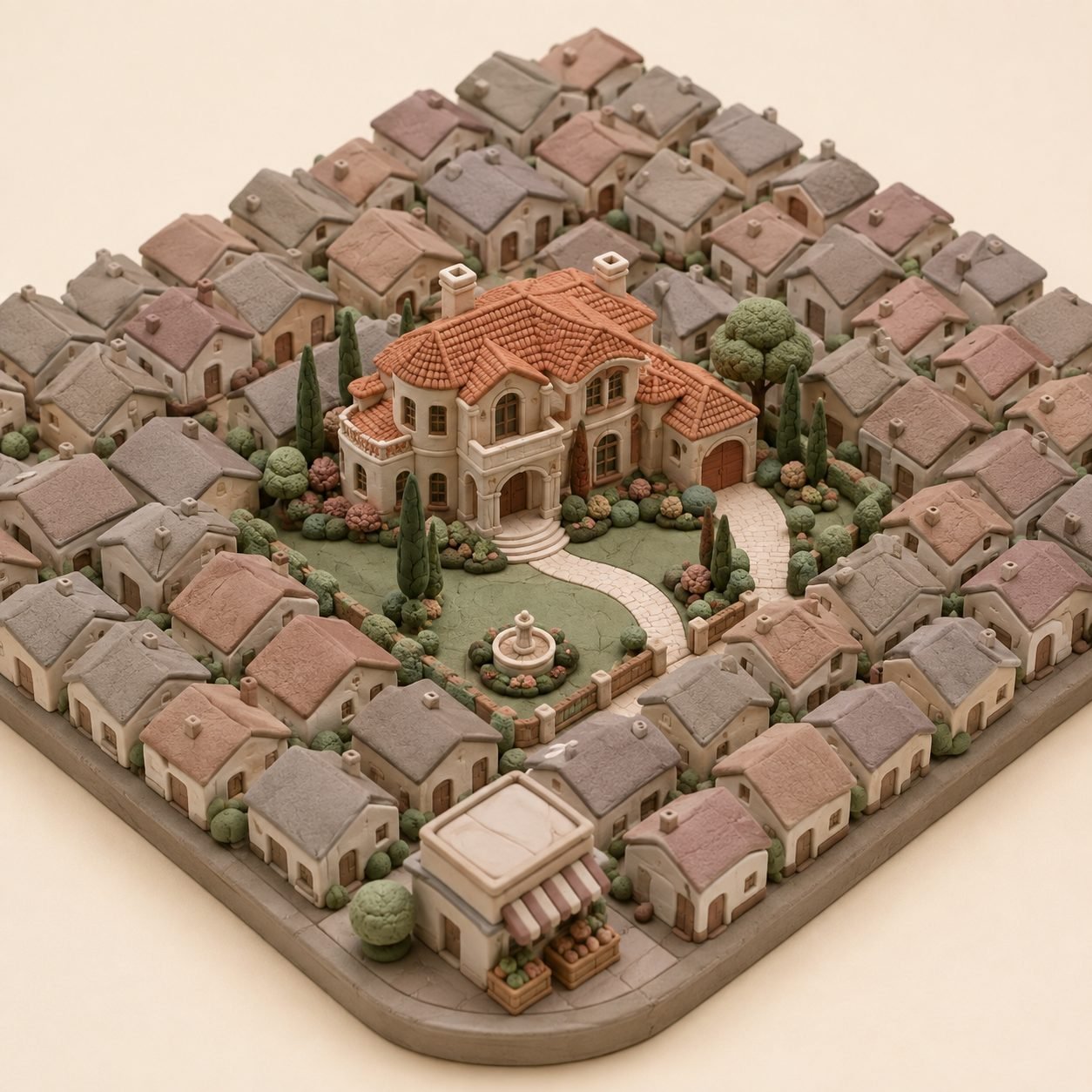
- Centurion American took 22 acres and built The Montclair, a gated community of about 25 luxury homes, constructed literally around the mansion. The house was rebranded Chateau Montclair, like a polite new neighbor introducing itself to the subdivision that had grown up around it.
- MQ Development Partners took the commercial corner and built the Shops at Prosper Trail, anchored by a Kroger Marketplace that opened in 2016.
A generation of Prosper families now lives on Deion's back forty. The town that could not support a $21 million mansion built its subdivisions around it instead. The town built itself out of his back yard.
Why the Land Was Liquid and the House Was Not
This is the development economics, and it governs every large-lot property in the corridor.
Land is divisible. A house is not. The acreage could be cut into 82 acres of production housing, 22 acres of luxury enclave, and a retail corner, each sized to a buyer pool that exists. The mansion could only be sold whole, to one buyer who wanted all 29,000 square feet including the bowling alley. Divisibility is liquidity.
Land buyers are institutions. Mansion buyers are individuals. Bloomfield and Centurion American are homebuilders with capital and a mandate to buy dirt in the path of growth. They do not need to love the property, they need the yield to pencil. The mansion needed one individual with $12.9 million, a taste for the specific, and a willingness to live in Prosper in 2014. That is not a market, it is a coincidence you wait for.
Improvements depreciate against a moving standard. Land does not. The land's value tracked Prosper's growth. The house's tracked how well a 1999 trophy build matched 2014, then 2019, then 2026 taste. Bowling alleys and 3,000-square-foot closets are not neutral square footage. They are square footage a later owner may pay to undo.
The highest and best use changed underneath the asset. In 1999 the best use of that dirt was a private estate. By 2014 it was residential development. The mansion was still priced as though 1999 applied, and that gap is most of the $16.5 million.
The Honest Counterargument: This Is Not a Comp
We should argue the other side, because the easy version of this story is lazy.
The Prosper mansion is not a normal listing and should not be used as a proxy for one. Trophy properties at 29,000 square feet have no market in the statistical sense. The buyer pool is a handful of people nationally in a given year, and with a pool that small, timing, taste, and luck matter more than at $500,000.
Some of the timeline is not a pricing story at all. The 2009 listing landed in the teeth of the financial crisis, a bad moment to ask $21 million for anything. The 2022 transfer went through bankruptcy court, a distressed process that is not evidence about market value. And celebrity cuts both ways: it generates attention, not qualified buyers.
Finally, the 79 percent figure is genuinely misleading alone, which is why we keep flagging it. Nobody lost 79 percent of anything. The land sold separately in 2014, at an undisclosed price, into a rising Collin County market. The whole-asset return on that 109 acres is unknowable from public information, and may well have been excellent.
What survives is the mansion-only sequence, all per CandysDirt: $12.9 million ask, auction stalled under $4 million, re-ask at $14.5 million, $7.5 million, $4.5 million close. That progression is a pricing story, and a clean one, because the market named the number in 2014 and the number did not change.
What Prosper Looks Like Today
Pull up Prosper on our DFW Market Map and the story continues at ordinary scale.
Over the last three months, 67.1 percent of Prosper sellers cut their asking price before closing, up from 58.2 percent in the same window a year earlier. Median sale price was $787,500, and the median listing took 55 days to go under contract. Those figures come from the Paragon MLS warehouse (NTREIS), pulled 2026-08-11, covering ZIP 75078 across 149 closings. Across 525 closings over a trailing twelve months, the median close was $796,000.
Two out of three Prosper sellers are mispricing their first ask by enough to require a public correction, and that share is nine points worse than a year ago. Prosper is not distressed: the median close is $787,500 over the trailing three months and $796,000 over the trailing twelve. What is deteriorating is not value, it is the accuracy of the opening number.
That is the same failure the mansion made. Different scale, identical mechanism. The difference is speed. The mansion asked $21 million and took 17 years to hear the market. In Prosper today you get the same information in about 55 days. It is much cheaper to listen early.
The Paragon Angle
The most expensive mistake in residential real estate is not the wrong agent, or skipped staging, or the wrong season. It is treating the list price as a negotiating position instead of a market hypothesis. Sellers routinely accept a higher number from whichever agent offers it, on the theory that a high price costs nothing to try. The Prosper mansion is a 17-year receipt proving otherwise.
Here is what we believe, and how we work:
The first 14 days are the entire test. That is when a listing reaches the buyers already watching the segment, and showing traffic in those two weeks tells you more than any comp set will. If the first two weeks are quiet, the price is the problem, and the correction should happen while the listing still has attention. Waiting turns a price problem into a stigma problem.
A price reduction is not a concession. It is a re-listing. Each cut buys one more shot at a fresh audience, and the shots are finite. The mansion spent its shots over 17 years and landed on the number the market named in 2014.
Long marketing time is priced by buyers, and not linearly. Past a market's median days, the buyer's question shifts from "what is it worth" to "what is wrong with it." In Prosper that median is 55 days, per the Paragon MLS warehouse (NTREIS), pulled 2026-08-11.
Improvements are not automatically value. Before a highly personal renovation, ask whether the next buyer would pay to keep it or pay to remove it. Bowling alleys are the extreme case. Wine rooms are the everyday one.
On acreage, run the split analysis before you list. On a large parcel in the growth corridor, the dirt and the improvements may be moving in opposite directions. That is the difference between selling a house with land and selling land with a house on it, and in Prosper it was worth more than the mansion.
For what it is worth, we do not think Deion Sanders built a foolish house. He built exactly what he wanted, where he could, in 1999. The market did what markets do, which is change. The mistake was not the build. It was the seventeen years spent asking the market to agree with a number it had answered.
Frequently Asked Questions
How much did Deion Sanders' Prosper mansion sell for?
It sold for $4.5 million in 2026, per CandysDirt, after going under contract in May 2025. It had most recently asked $4.995 million, following an April 2025 relisting at $5.5 million. Texas is non-disclosure, so every price here is as reported by CandysDirt.
Did the mansion really sell for 79 percent below its original asking price?
Roughly, with an asterisk. The 2009 ask of $21 million covered the mansion plus about 109 acres; the 2026 sale of $4.5 million covered the mansion on about 6 acres, per CandysDirt. That 78.57 percent gap spans two different assets. The cleaner mansion-to-mansion comparison is the 2014 ask of $12.9 million against the $4.5 million close, 65.1 percent below over twelve years. The land sold separately at an undisclosed price.
What happened to the 109 acres?
Sanders sold it off-market on August 29, 2014, at an undisclosed price, and it became Prosper. Per CandysDirt, Bloomfield Homes took about 82 acres for subdivisions, Centurion American developed 22 acres into The Montclair, a gated community of about 25 luxury homes built around the mansion, and MQ Development Partners built the Shops at Prosper Trail with its 2016 Kroger Marketplace. The mansion was rebranded Chateau Montclair.
Why did the mansion take 17 years to sell?
We will not speculate about individual buyers' reasons. What the record shows is a sequence, all per CandysDirt: $21 million in 2009, $12.9 million in 2014, a failed no-reserve auction that year with bidding stalled under $4 million, a higher re-ask at $14.5 million in 2016, $7.5 million in 2019, and a $4.5 million close in 2026. The 2014 signal and the 2026 close sit within roughly half a million dollars of each other.
What does this have to do with a normal Prosper home sale?
The mechanism is identical, just quieter. Over the last three months, 67.1 percent of Prosper sellers cut their asking price before closing, up from 58.2 percent a year earlier, with a median sale of $787,500 and a median 55 days to contract, per the Paragon MLS warehouse (NTREIS), pulled 2026-08-11. Two out of three sellers here are correcting a first price in public. The mansion did it slower, with more zeros.
Is a very large custom home always a bad investment in DFW?
Not always, but the buyer pool shrinks faster than the square footage grows, and highly specific improvements shrink it further. Price an unusual property against the buyer pool that exists, not against what the improvements cost to build. Replacement cost is what you spent. Market value is what someone will pay.
Conclusion
Deion Sanders built a 29,000-square-foot house on 109 acres in a town of about 1,752 people, and the town grew up around it, through it, and past it. Bloomfield built the subdivisions. Centurion American built the gated enclave that now surrounds the house. Kroger opened in 2016. Prosper ate it.
The land won because land in the path of growth is divisible, institutionally desirable, and priced by what the site can become. The house lost because it was indivisible, individually desirable at best, and priced by what it once was. Those are not celebrity dynamics. They are the ordinary physics of real estate, legible here only because it all happened in public with famous numbers attached.
What generalizes is the first price. The market named this property's value in a 2014 auction room, and that number is within a rounding error of what closed in 2026. Everything between was the cost of not accepting the answer. In Prosper today the same answer arrives in about 55 days rather than 17 years, which is a mercy if you use it.
If you own property in Prosper, Celina, Frisco, or anywhere in the northern growth corridor, the question before you list is not "what would I love to get." It is "what does the market already know, and how fast am I willing to hear it."
Ready to price a Prosper listing against what the market will actually pay? Let's connect and discuss your goals.
Reach us at [email protected] or call (469) 290-7593. More at paragondfw.com/contact.
Sources
- CandysDirt, "Deion Sanders' Famous Prosper Mansion Finally Sells For $4.5 Million," August 11, 2026. Source for the $4.5 million sale, the $4.995 million and $5.5 million 2025 asks, and the May 2025 contract date. https://candysdirt.com/2026/08/11/deion-sanders-famous-prosper-mansion-finally-sells-for-4-5-million/
- CandysDirt, same article. Listing history: $21 million (2009-2011, about 109 acres), $12.9 million (2014, mansion only), the failed 2014 auction with bidding stalled under $4 million, $14.5 million (2016-2017), $7.5 million (2019), the 2021 sale, the 2022 bankruptcy-court transfer.
- CandysDirt, same article. Property: built 1999, about 29,000 square feet on about 6 acres, plus the amenity list.
- CandysDirt, same article. Land disposition: the August 29, 2014 off-market sale at an undisclosed price, Bloomfield Homes at about 82 acres, Centurion American's 22 acres and The Montclair's roughly 25 homes, the Chateau Montclair rebrand, and the Shops at Prosper Trail with its 2016 Kroger.
- U.S. Census Bureau, Population Estimates Program, "SU-2000-10," Texas file. Prosper town, Collin County: July 1, 1999 estimate of 1,752; April 1, 2000 census count of 2,097. https://www2.census.gov/programs-surveys/popest/tables/1990-2000/2000-subcounties-evaluation-estimates/sc2000f_tx.txt
- Paragon MLS warehouse (NTREIS), pulled 2026-08-11. ZIP 75078, trailing three months through August 10, 2026, 149 closings: 67.1 percent cutting versus first ask, median close $787,500, median 55 continuous days. Year ago: 58.2 percent.
- Paragon MLS warehouse (NTREIS), pulled 2026-08-11. ZIP 75078, trailing twelve months, 525 closings: median close $796,000.
- Derived arithmetic, shown above: ($21.0M less $4.5M) / $21.0M = 78.57 percent, quoted as "about 79 percent" with the acreage caveat; ($12.9M less $4.5M) / $12.9M = 65.1 percent mansion-only; ($14.5M less $7.5M) / $14.5M = 48.3 percent; 2009 to 2026 = 17 years; 2014 to 2026 = 12 years.
- Attribution note: Texas is a non-disclosure state, so residential sale prices are not public record. Every price here is as reported by CandysDirt.